Source: a due-diligence post on r/biotech_stocks by u/Fun-Time4064, late August 2026, plus its comment section. The thesis, the funnel and the platform argument below are theirs. The recomputations, the filing checks and the catalyst calendar are ours. The post went up four days before Clinuvel reported FY2026, so some of what follows was not available to the author and some of it was.
The claim
Three arguments are braided together in the post, and they have very different amounts of support behind them.
The first is a valuation claim: US$226m of enterprise value for a business that earned US$26m of net profit at a 34% net margin, with revenue compounding at 20% or better and 42% of the market cap sitting in cash.
The second is a catalyst claim: a Phase 3 vitiligo readout in December 2026 on a market the company sizes at US$4.5b, with the commercial channel already built, 190 accredited centres standing, and regulatory filings following through 2027.
The third is an option claim: a controlled-release peptide delivery platform, funded by operating cash flow, carried in the price at zero.
The valuation claim is close to right, and the FY2026 accounts made it more so. The catalyst claim is wrong in a way that changes the shape of the next three years. The platform claim rests on figures we could not find in any release.
The arithmetic, in one currency
Clinuvel reports in Australian dollars. Its Nasdaq ADSs trade in US dollars, its 20-F presents translated US-GAAP statements, and the post takes numbers from all three.
The specific mix in the post: the FY2025 profit and loss, the 31 December 2025 cash balance, and a spot exchange rate near A$1 = US$0.717. The 20-F translates at A$1 = US$0.650335 as of 30 June 2025, which is why the US$167m of cash in the post does not appear in any filing. At the 20-F rate the same balance is US$155m. The two multiples in the post do not reconcile with its own inputs either: US$226m over US$26m is 8.7x, not 9.7x, and US$393m over US$26m is 15.1x, not 17x.
None of that changes the conclusion much. Doing it in Australian dollars against the FY2026 accounts does.
| Post, late Aug 2026 | Today, 30 Sep 2026 | |
|---|---|---|
| Price | US$7.80 | US$6.00 (A$8.60) |
| Shares | 50.4m | 50.43m |
| Market cap | US$393m | US$302m (A$434m) |
| Cash reserves | US$167m (H1 FY26) | A$252.1m (30 Jun 2026) |
| Enterprise value | US$226m | A$182m |
| Net profit | US$26m (FY25) | A$33.9m (FY26) |
| EV / net profit | 8.7x | 5.4x |
| Cash as % of price | 42% | 58% |
The enterprise value fell by more than the share price because the cash balance grew 12% over FY2026 while the equity fell. Cash reserves per share are now A$5.00 against an A$8.60 price, so the operating business is being marked at A$3.60 a share, and net tangible assets are A$5.35. On the post's own framing, the stock is cheaper now than when the post was written, by a wide margin.
Revenue stopped growing before the post went up
FY2026 revenue was A$94.0m, down 1%. Net profit after tax was A$33.9m, down 6%. Profit before tax was A$47.7m, down 8%. The report calls FY2026 the tenth consecutive profitable year, which it is.
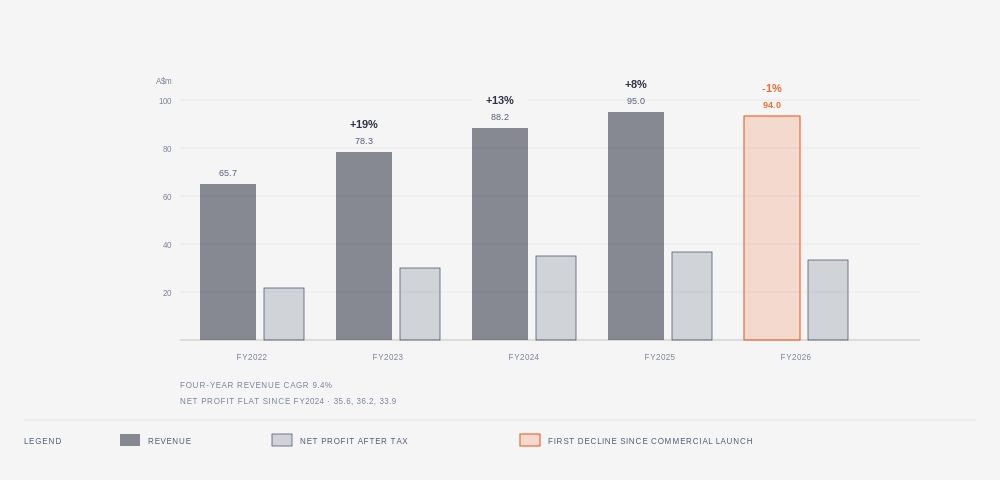
Revenue grew 19%, then 13%, then 8%, then fell 1%. The four-year CAGR to FY2026 is 9.4%, not the 20%-plus the post advertises as the current rate. Net profit has been flat for three years: A$35.6m, A$36.2m, A$33.9m. The post's revenue CAGR figures are backward-looking off a base that stopped compounding in FY2024.
Two more corrections to the financial summary. Gross margin is 83.2%, per the CEO's own letter in the annual report, not "north of 90%". And the 34% net margin is 36% on operating revenue if you use the company's definition, or 36% of the A$94.0m revenue line, depending on which denominator you pick. That one is in the post's favour.
The composition of FY2026 is more interesting than the headline. Global treatment volumes rose 6% to a record while revenue fell 1%, so revenue per dose fell about 7%. The volume that grew was European and the volume that shrank was American:
- In September 2025 the EMA approved an amendment raising the permitted maximum from four treatments per patient per year to six. European treatment volumes rose 13% on the back of that plus patient growth. It is a label change, so it lifts the run rate once.
- US volumes moderated because EPP patients moved into competitor clinical studies and compassionate use programs "where investigational therapies were supplied without charge", and because US Specialty Centers switched from holding inventory to just-in-time ordering.
Mix is the likeliest explanation for the fall in revenue per dose, since the disclosure does not separate price from geography. Either way, both movements are one-offs pointing in opposite directions, and the American one is competitive rather than seasonal.
December is the first pivotal, not the filing
CUV105 is real and on schedule. It enrolled 210 patients with Fitzpatrick III to VI skin types across 30 sites in the United States, France, Kenya and the United Kingdom. It is randomised, parallel-arm and open label, comparing afamelanotide plus narrow-band UVB against NB-UVB alone over 20 weeks. The primary endpoint is the proportion reaching T-VASI50, meaning at least 50% total body repigmentation, at Day 140. Published case studies show the dosing: seven implants and 39 to 40 NB-UVB treatments. Topline is guided for December 2026.
The obvious objection to an open-label trial with a visually scored endpoint is investigator bias. The company's answer is centralized photographic analysis on top of the validated VASI tool, which is the right answer and worth crediting. The registry entry still lists a December 2025 primary completion and a June 2026 study completion, so the public record is stale against the company's own guidance.
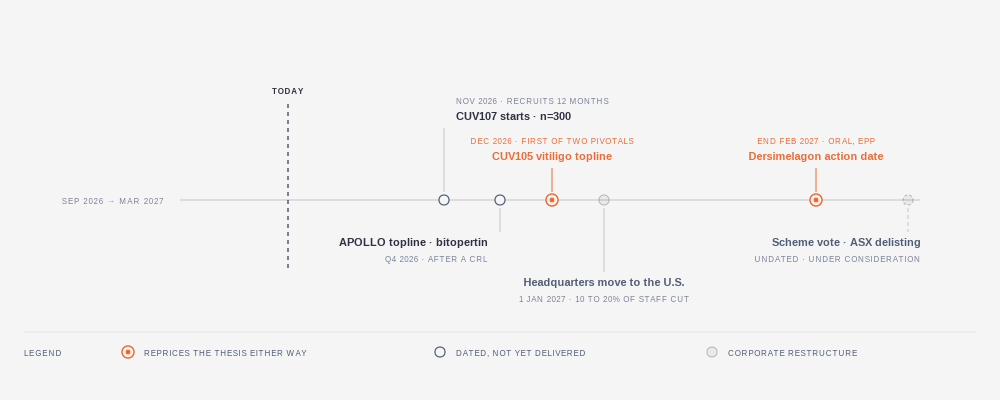
What the post misses is what comes after. From Clinuvel's own filing on the vitiligo program: CUV107 is a second pivotal Phase 3 in 300 patients with Fitzpatrick IV to VI skin types, the EMA reviewed its protocol in April 2026, it is scheduled to start in November 2026, and it has a 12-month recruitment period. The filing is explicit that regulators expect robust data rather than a single pivotal trial as a benchmark.
So the sequence is not readout, then filings through 2027. It is readout in December 2026, a second 300-patient trial that begins the month before that readout and recruits through late 2027, then treatment and follow-up, then a submission. The same risk is named in the CEO's letter in the annual report: "regulators could ask for more than we've modelled."
There is also the question of what CUV105 has to beat. The company's own benchmark table, filed with the SEC, puts NB-UVB monotherapy at 45% achieving clinically significant repigmentation in one 176-patient study and 19 to 36% marked response across a meta-analysis of 1,428 patients. NB-UVB is the control arm. For comparison, oral upadacitinib reported 19.4 to 21.5% T-VASI50 and topical ruxolitinib 45 to 50% F-VASI50 on the face. A 20-week total-body endpoint against an active comparator that already works is a harder test than the post's framing suggests.
The competitor that got the CRL was not the competitor that matters
The best-informed comment in the thread was also the most wrong in its conclusion. u/Acrobatic_Situation1 wrote:
It's worth mentioning that their closest competitor in EPP got issued a CRL from the FDA.
and linked to CRL_NDA220707_20260213.pdf, with u/Fun-Time4064 agreeing that it "definitely helps
secure their monopoly position in EPP."
NDA 220707 is bitopertin, from Disc Medicine. The CRL was issued on 13 February 2026, and the reason is worth reading: the FDA accepted that bitopertin lowers whole blood metal-free PPIX, but concluded the trials did not show an association between that biomarker and sunlight-exposure endpoints. The agency pointed at the ongoing Phase 3 APOLLO study as a path to traditional approval. APOLLO topline is due in Q4 2026, the same quarter as CUV105.
The competitor that matters is dersimelagon, and it did not get a CRL. It is a once-daily oral MC1R agonist, which is the same receptor family as afamelanotide delivered as a pill rather than an implant. On 18 September 2026, three weeks after the thread, LEO Pharma announced that the FDA had accepted the NDA with Priority Review for EPP and X-linked protoporphyria, with a target action date at the end of February 2027. LEO closed the acquisition from Tanabe at the same time, for up to US$435m in upfront and near-term milestones plus tiered royalties.
Set that against Clinuvel's A$182m enterprise value and it reads two ways. Either the market is mispricing an approved franchise with ten years of revenue behind it, or LEO Pharma has just paid more than that for the pre-approval asset it expects to take the market with. The FY2026 US revenue softness, caused by patients leaving SCENESSE for free investigational drug, is what the competitive pressure looks like before either competitor is approved.
The commercial build is a mid-2027 target
The post treats the channel as finished: "190 trained and accredited treatment centres, a 20 person national distribution team." The annual report says 134 Specialty Centers are trained and accredited in North America, 129 in the United States and 5 in Canada, as of 30 June 2026, and that the network "is targeted to increase to 190 by 30 June 2027." The 190 is the plan for the initial vitiligo commercial launch, not the current state. The over-100-insurer reimbursement figure in the post is accurate.
On 23 July 2026, a month before the thread, Clinuvel announced a strategic reorganisation: corporate headquarters moving to the United States effective 1 January 2027, and a reduction of the global workforce by approximately 10% to 20%, described in the release as "a necessary realignment of operating expenditure with current revenue generation." A company cutting a sixth of its staff to match spending to revenue is not a company whose commercial build is already paid for. The expenditure guidance is a five-year average of no more than A$55m a year, and FY2026 came in at A$53.5m, so the ceiling on the vitiligo launch spend is already set.
What the vitiligo model actually says
The funnel in the post is the company's own, reproduced faithfully, and the two figures we can source directly are in the annual report: a US$4.5b addressable market in the United States and "projected revenues of US$490–570 million in the first two years of distribution", from roughly 5,900 patients at 9% penetration of about 66,000 actively seeking treatment.
Divide it out. US$490m to US$570m over two years across 5,900 patients is US$83,000 to US$96,000 per patient, or roughly 14 implants at US$6,000 to US$6,900 each on the trial's schedule of seven implants per course. Clinuvel has never published a vitiligo price, so the model's central assumption is the one input it does not state. The US$4.5b headline divided by 66,000 patients implies US$68,000 per patient per year, which is a different number again, so the two company figures do not sit on the same price.
Scale matters more than the price. The midpoint of US$530m over two years is US$265m a year, about four times total FY2026 group revenue, from 5,900 US patients, against an EPP franchise that took ten years and five jurisdictions to reach 21,000 cumulative implants. None of that makes the model wrong. It makes the model the entire thesis, which is a different thing from a free option attached to a profitable business, and it should be sized accordingly.
One internal inconsistency worth flagging, both sides of it from the company. The funnel starts at 3,295,000 US patients, which is 1% of the population. The July 2026 reorganisation release puts the US vitiligo population at "approximately six million affected." The denominator differs by a factor of two between two 2026 company documents.
The platform, and the number we could not find
The post's summary of the 12 August 2026 VLRX-L update is accurate. We checked it line by line against the release: four candidate formulations went into a preclinical study, one showed a superior release profile over the target window with lower peak plasma levels, the candidate is being refined, a further preclinical study is scheduled for early Q1 2027, and manufacturing scale-up is being scoped. Credit where it is due.
The scaffolding around it is thinner than the post suggests.
The S$30m over five years does not appear in the December 2025 expansion announcement, which gives no dollar figure, no footprint measurement and no headcount target. The only EDB commitment we could find a number for is up to S$500,000, from 2020. The announcement targets full commissioning and certification for FY2028, with the first phase complete late in calendar 2026. The "over 50 people" R&D headcount is not in any release we could find.
The licensing argument is also an extrapolation. The VLRX-L release says the initial focus is melanocortins and that the work has produced "clearer pathways that are being pursued for a range of peptides." It does not say the platform will be licensed or partnered to third-party peptides. Nor does the Singapore announcement.
Scale check on the spend. Clinical and non-clinical development expenses were A$3.39m in the half to 31 December 2025, out of A$25.98m of total expenses. That is the line funding a Phase 3 close-out and the preparation of a 300-patient second pivotal. The platform is being run out of a small absolute budget, which is consistent with the CEO's description of biweekly formulation experiments, and inconsistent with the post's picture of a decade-plus program that makes the delivery category's central problem go away.
The newest piece is ZEROKIN, announced 8 September 2026: a single-use subcutaneous administration device for the controlled-release formulations. An IP application has been submitted. The commercial manufacturer has not been appointed and the Class II 510(k) dossier has not been filed.
On the rest of the free pipeline, one detail changes how to read it. The company's stated objective for NEURACTHEL is US approval "to distribute it as a generic drug" for central nervous system conditions. Generic ACTH is a different business from the one the post's framing implies.
Scoring the thread
Right, and worth saying because it is unusual: the business is genuinely profitable, genuinely debt-free, has never diluted, and the cash is real and verifiable. u/begmanii and u/Outlier_Economist were right about liquidity, and 206 shares traded on 21 August is the correct thing to notice in a company where 66% of the register is foreign and only 9.72% of shares sit in the US. u/havenyahon gave the best explanation of the chart: the melanocortin tanning-cream hype of the early 2010s set expectations the science could not meet, and the register has been working that off since. The VLRX-L summary was accurate.
Wrong: the CRL secured nothing, the 190 centres are a 2027 target, gross margin is 83.2%, revenue is not compounding at 20%, filings do not follow through 2027, and the S$30m is unsourced.
The argument nobody in the thread made is the one with a shareholder vote attached. Clinuvel is considering moving its primary listing from the ASX to Nasdaq under a new foreign parent company, through a scheme of arrangement, with a concurrent ASX delisting. Headquarters relocate on 1 January 2027. For Australian holders that means the fully franked dividend, which is a material part of the after-tax return on a 5c payout, stops being franked. The thread treats the Nasdaq listing as free distribution upside. It is the first phase of a two-stage restructure that requires an extraordinary general meeting, and it lands in the same window as the readout.
Where we land
The post's cheapness argument survived contact with the FY2026 accounts and got stronger. Enterprise value is A$182m against A$33.9m of net profit, a 5.4x multiple, with A$5.00 a share of cash inside an A$8.60 price. If nothing else happened, that would be a defensible thing to own.
The growth argument did not survive. Revenue fell 1%, profit fell 6%, profit has been flat since FY2024, and the growth that did happen came from a European label change rather than from the franchise widening.
The catalyst argument needs to be restated. December is a 210-patient open-label readout against an active comparator, and it is the first of two pivotals the company says regulators want. A positive result starts a second 300-patient trial, not a filing. Between now and the end of February 2027 there are three other dated events: bitopertin's APOLLO topline in Q4 2026, the CUV107 start in November, and the dersimelagon action date at the end of February. Two of those three are competitors moving into the revenue base that funds everything else.
The platform is a real program on a small budget, in a facility the company does not expect to have fully commissioned and certified until FY2028.
Not investment advice. We hold no position.
Sources
- u/Fun-Time4064's DD on r/biotech_stocks, plus comments from u/Acrobatic_Situation1, u/havenyahon, u/begmanii, u/Outlier_Economist and u/A-Money-Lover
- CLINUVEL FY2026 annual report and Appendix 4E, 27 August 2026
- A decade of profitability provides foundation for CLINUVEL's U.S. expansion, 27 August 2026
- CLINUVEL Appendix 4D, half year ended 31 December 2025
- CLINUVEL Form 20-F registration statement (share count, shareholder table, translation rates, customer concentration)
- CLINUVEL implements strategic reorganisation to refocus on U.S. markets, 23 July 2026
- CLINUVEL's injectable peptide platform: VLRX-L update, 12 August 2026
- CLINUVEL develops proprietary ZEROKIN device, 8 September 2026
- CLINUVEL expands Singapore RD&I Centre, 8 December 2025
- CLINUVEL 6-K on the vitiligo program: CUV105 and CUV107
- CLINUVEL 6-K on vitiligo efficacy benchmarks
- CUV105 registry entry, NCT06109649
- Disc Medicine receives Complete Response Letter from FDA for bitopertin, 13 February 2026
- LEO Pharma announces FDA acceptance of dersimelagon NDA with Priority Review, 18 September 2026
Discussion
Nobody has replied yet. If the argument here is wrong, say so.