Source: a due-diligence post on r/stocks by u/SeattleOligarch, April 2026, plus its comment section. They disclosed 1,350 shares and 500 warrants and asked readers to break the thesis. Two of them did. The corrections below are u/ScottyStellar's and u/kuyawake's, not ours. We've checked the arithmetic and updated the facts to today.
The claim
Alpha Tau Medical makes Alpha DaRT: stainless steel seeds coated in Radium-224, inserted directly into a solid tumour. The radium decays and releases alpha particles that destroy tumour DNA from the inside. The seeds sit in place about a month, then come out. Both procedures are outpatient.
The author's framing of why this matters:
It's like using a scalpel vs. traditional radiation therapy's chainsaw.
Alpha particles travel a very short distance, so the damage stays inside the tumour instead of spreading into whatever sits next to it. That is the pitch for tumours wrapped around things you can't irradiate or cut: pancreas, brain, head and neck.
The stock was around $7 when the post went up. It's $11.79 now, roughly a $1.07 billion market cap.
The model, and the step it skips
The author's revenue math:
| Input | Value |
|---|---|
| Annual cSCC (skin) patients, US | ~64,000 |
| Annual pancreatic patients, US + Japan | ~100,000 |
| Revenue per treatment (analyst range) | $20,000 to $125,000 |
| Fully commercialised revenue | $3.28B to $20.5B |
Run it: 164,000 × $20,000 = $3.28B. 164,000 × $125,000 = $20.5B. The model treats every diagnosed patient in those indications as an Alpha DaRT patient. There is no market-share step.
u/ScottyStellar said so plainly:
64000 is the TAM for skin cancer patients they would treat. They expect to take a slice of that, not all of it.
The author took it well and suggested 15% as a more realistic reach. Apply that to his own model, keeping the same 30% discount rate, the same dilution assumption and the same 2033 date, with only the revenue line changed. The target range falls by a factor of about 6.7.
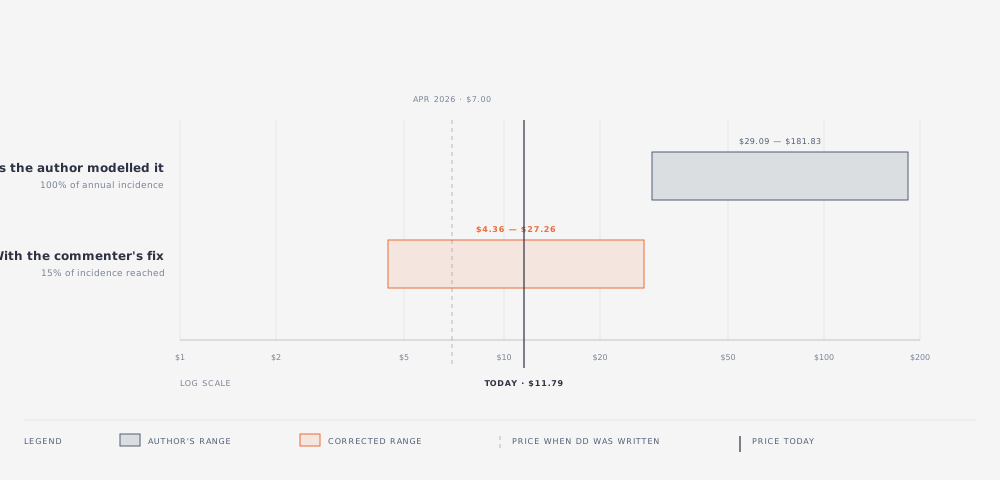
The two ranges don't overlap. The corrected top end sits below the original bottom end, and today's $11.79 lands inside the corrected range rather than at a 4-to-25x discount to it.
That's not a refutation of the company. It's the difference between "the market is wildly mispricing this" and "the market has roughly figured out what this is." Those call for very different position sizes.
Two smaller gaps in the same model, for completeness:
- It converts revenue straight to share price with no margin or multiple step stated.
- Under the June 2026 Tolmar deal, Alpha Tau supplies product for US prostate at 60% of onward net sales. In partnered indications, headline treatment price is not what Alpha Tau books.
The bear case worth reading
The most valuable comment in the thread came from u/kuyawake, who writes like a medical physicist. Their argument is not that the technology fails. It's that the 6-year adoption ramp is fantasy. Summarised:
- Oncologists won't switch on local tumour control alone. They want survival data against standard of care, and that data takes longer than six years to generate.
- Alpha emitters are a different safety regime. A clinic needs a program for shipping, handling and storing the sources, and for managing the radon gas released as the radium decays. That is beyond what a normal external-beam department is set up for.
- Measuring absorbed dose from an alpha source is harder than from photons or electrons, and there are no AAPM guidelines for Alpha DaRT yet.
- Conformal radiotherapy already exists. SRS, SBRT, Gamma Knife, CyberKnife, proton therapy and brachytherapy all put targeted dose into small tumours. Alpha DaRT has specific advantages in specific cases, not a general one.
- Then the unglamorous blockers: administrator buy-in, billing codes, insurance approval.
Their conclusion: "Alpha dart is a baby." Promising, but likely confined to research settings longer than the model assumes.
The best counter came from u/OhNoPot, who has a brain tumour and follows the space closely: when the INDIGO trial read out, oncology uptake was fast, not decade-slow. A convincing GBM result can move the system quickly because the alternative is so bad. That's a fair rebuttal, and it's the specific case where kuyawake's general rule is weakest.
About that 100% response rate
A separate r/biotech_stocks thread celebrated "100% Objective Response Rate" with Keytruda and was baffled when the stock fell. Worth being precise about what was announced in July 2026:
- The indication is locally advanced or metastatic head and neck squamous cell carcinoma in elderly patients, not skin or pancreatic.
- Nine evaluable patients: four complete responses, five partial. The study stopped after 11 patients because a two-stage adaptive design hit its pre-specified success threshold.
- Median overall survival 18.2 months, PFS 5.4 months, versus historical pembrolizumab figures of 12.3 and 3.2 months. That's a comparison against historical data, not a randomised control arm.
- No Alpha DaRT-related serious adverse events.
The safety signal is real and the efficacy signal is encouraging. But nine patients against a historical benchmark is a reason to run a bigger trial, not a reason to reprice a company. The stock had already run roughly 25% into the print. Commenters called the drop "the market making no sense." It made sense.
The same caution applies to REGAIN, the glioblastoma trial: 100% local disease control and a 67% complete response rate in the first three patients of a ten-patient study.
The catalyst nobody polled for
A poll in r/DRTS_Stock asked which catalyst lands next. 210 votes across six options: IDE approval (53), news from Japan (48), ReSTART or other clinical data (39), a new deal (38), prostate trial start (15), trial recruitment (17).
Every option is good news. That's the structural thing to notice about a single-ticker subreddit. It selects for holders, so its sentiment reading tells you about the sub, not about the stock. No accusation intended; several members there are thoughtful, and the mod explicitly labels it a discussion forum. It's just not a sample.
Here's what the poll left off:
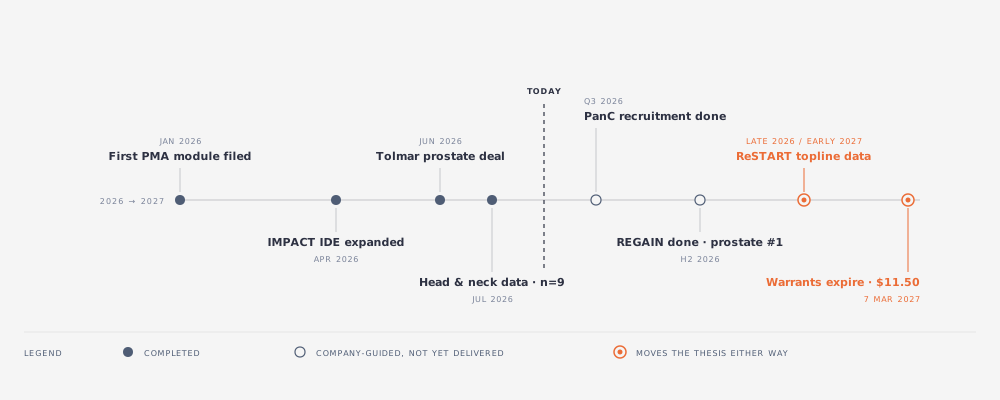
The DRTSW warrants expire March 7, 2027, at a $11.50 strike. The stock is $11.79. They just went in the money, and there are up to 36.7 million shares underlying all outstanding warrants, options and RSUs against 92.3 million shares currently outstanding. That's a larger dilution overhang than the DD's 30% assumption, and it resolves inside the next seven months either way.
Reading the financials without panicking
Alpha Tau reported a $68.8 million net loss for the first half of 2026, up from $18.8 million a year earlier. Most of that is not the business burning money:
| Line | H1 2026 |
|---|---|
| R&D | $20.9M |
| G&A | $5.7M |
| Marketing | $0.6M |
| Operating spend | ~$27.2M |
| Financial expenses (mostly warrant remeasurement) | $41.4M |
| Cash, equivalents and deposits at June 30 | $104.8M |
| Revenue | none |
The $41.4 million is a non-cash accounting charge that grows when the share price rises, because the warrants become more valuable. A rising stock mechanically produces a bigger reported loss. Operating spend of roughly $27 million per half against $104.8 million of cash is about two years of runway, before the $35 million from Tolmar and any warrant exercise proceeds.
Where we land
The author did the thing almost nobody does: published a model, asked to be corrected, and accepted the correction when it came. The thread is better than the post, which is a compliment to the post.
What survives: a genuinely differentiated device, Breakthrough Device Designation in two indications, a completed 88-patient pivotal trial with topline data due within months, a real partner writing real cheques, and a clean safety record so far.
What doesn't: the 4-to-25x upside. That number came from multiplying every cancer patient in two indications by an analyst price. Corrected for market share, the stock is somewhere between fairly valued and modestly cheap, which is a much more ordinary thing to own.
The two events that actually matter are ReSTART topline data in late 2026 or early 2027, and the warrant expiry in March 2027. Everything on that poll is noise by comparison.
One last thing, said gently. Several people in these threads described buying because a parent died of pancreatic cancer, and framed the position as a donation they might get paid for. That's a decent impulse and we are not going to sneer at it. But conviction sourced from grief is very hard to size correctly, and this is a pre-revenue company with a dilution event in seven months. Size it like the binary it is.
Not investment advice. We hold no position.
Sources
- u/SeattleOligarch's DD on r/stocks, plus comments from u/ScottyStellar, u/kuyawake and u/OhNoPot
- u/Pristine_Hurry_4693's catalyst poll, r/DRTS_Stock
- Alpha Tau: 100% ORR with pembrolizumab in head and neck cancer
- Alpha Tau: Q2 2026 financial results and corporate update
- Alpha Tau: FDA clearance to complete REGAIN enrollment
- Alpha Tau registers for TASE dual listing
- Alpha Tau Medical investor presentation (the DD's slide 70 pricing source)
Discussion
Nobody has replied yet. If the argument here is wrong, say so.