Source: @a_i_m_rue on X, September 8, 2025, plus a February 2026 follow-up thread. The thesis and the modeling below are theirs. They disclose GRAL as their largest position. Everything we add is marked as ours.
The claim
Grail sells a blood test, Galleri, that looks for signs of 50-plus cancers at once. The pitch is that screening, not treatment, is where the biggest gains against cancer are left, and that Grail has a multi-year head start on the only market that matters.
The author's framing, compressed:
This is not a short term play, but an ev/sales of 4 on the company that will save more lives than any other this century is a steal.
They size it at $500 billion to $1 trillion in a decade. That is their number, and it is a big one.
How the test works, in plain terms
Tumours shed DNA into your bloodstream. That DNA carries chemical tags called methylation marks, which differ between healthy cells and cancer cells. Grail runs a machine learning model over those tags to answer two questions: is there cancer, and where is it.
The part that matters commercially is that the model gets better with data. More tests run means more labelled examples means higher sensitivity. The author expects this to produce a winner-take-most market, because a lagging test has no reason to exist once a leading one is reimbursed. Grail has run 500,000-plus tests and holds the foundational methylation patents, so rivals have to engineer around them, which the author argues costs them accuracy.
The market math
All of this is the author's modeling:
- 300 million people over 50 in developed markets
- Annual testing, at an assumed $500 per test
- ≈ $150 billion screening market, plus ≈ $50 billion in adjacent diagnostics and residual-disease testing
Nobody is being paid $500 a head today. Galleri is currently sold without insurance coverage and without consumer marketing, because it is not FDA approved yet. So treat this as a ceiling sketch, not a forecast.
Then the trial read out
Grail ran NHS-Galleri: 142,250 people aged 50 to 77, three annual screening rounds, randomised and controlled. It is the only trial of its kind for any multi-cancer test. Topline came in February 2026, full results at ASCO in June.
It missed its primary endpoint. The trial was designed to show fewer cancers caught at stage 3 or 4 combined. The result was an incidence rate ratio of 1.03 (95% CI 0.92–1.14, p = 0.63), a 3% increase, statistically indistinguishable from no effect.
But the secondary results were not flat at all:
| Measure | Result |
|---|---|
| Stage 4 diagnoses, all three rounds | −14% (IRR 0.86, CI 0.744–0.998) |
| Stage 4, round 2 / round 3 | −22% / −26% |
| Stage 1 and 2 detection, 12 target cancers | +16% |
| Cancer detection rate vs standard screening | 4× |
| Emergency presentations | −25% |
| Positive predictive value | 52.0% |
| Specificity | 99.55% |
| Sensitivity, 12 target cancers / all cancers | 54.7% / 30.7% |
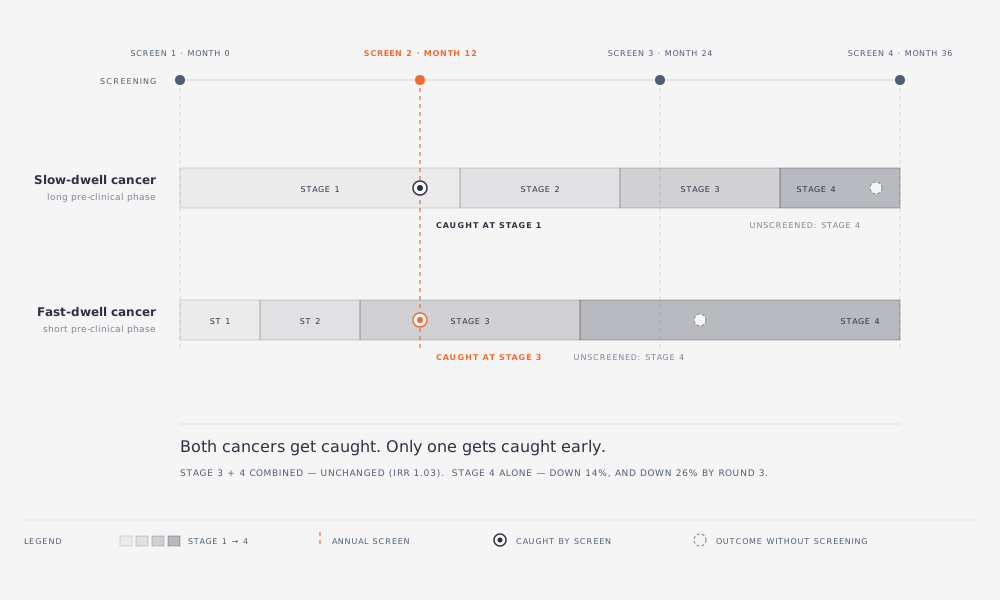
So stage 4 went down meaningfully, stage 3 went up enough to cancel it out in the combined endpoint.
The dwell-time explanation
This is the interesting part, and the author got to it in February, four months before the full ASCO data confirmed the shape of it.
Dwell time is how long a cancer sits at a given stage before progressing. The trial was designed assuming dwell times long enough that one test a year would catch a cancer at stage 1 or 2. For a large share of cancers, that assumption was wrong. They move faster than that.
If a cancer's dwell time is shorter than your screening interval, annual testing does not move it from stage 4 to stage 1. It moves it from stage 4 to stage 3. You save the patient from the worst outcome, and the combined stage 3+4 endpoint records nothing.
Layer on the second problem: some cancers barely shed DNA into blood while they are small and localised. Brain and kidney are the author's examples. For those, early-stage sensitivity is low for reasons of biology, not model quality.
The author's proposed fixes, and their modeled effects:
- Test twice a year. Modeled at −34% stage 4 and −19% for stage 3 and 4 combined.
- Test more than blood: urine, saliva, breath, spinal fluid, plus cfRNA alongside cfDNA. Modeled to push the reduction into the mid-40s percent. They note Grail has presented data or filed patents on all of these.
- Move faster on positives. A separate June 2025 post: the current baseline is 48 days from a positive test to a diagnosis. Cutting that to two weeks for fast-moving cancers could save 10,000 lives a year at population scale, at no marginal cost, just reserved imaging and biopsy slots released on a rolling basis if no positive shows up.
The honest cost of this: roughly $1,800 a year per person instead of $500. The author says so directly, and that it "is going to dramatically hurt the cost effectiveness."
What has to be true
For the thesis to work:
- FDA approves Galleri, unlocking consumer marketing and the start of insurance coverage.
- Payers accept a test whose randomised trial missed its primary endpoint, on the strength of the stage 4 and emergency-presentation numbers.
- The data flywheel is real, and sensitivity improves fast enough that competitors never catch up.
- Multi-fluid and higher-frequency protocols work roughly as modeled, at a price people will pay.
- Grail funds itself to profitability without destroying the equity.
What breaks it
- The endpoint miss is what payers see first. A regulator can weigh secondary endpoints. A cost-effectiveness body facing a $1,800-a-year per-person bill is a harder audience, and NHS-Galleri did not produce a mortality result. That takes years more follow-up.
- A 52% PPV cuts both ways. The author is right that it beats most screens, which sit at 5 to 10%, and right that low PPV is mostly an artifact of cancer being rare. But half of positives still send a healthy person through a cancer workup.
- The dilution the author flagged, a secondary near approval, is still coming.
- The 300 million × $500 market is a sketch. Real MCED adoption depends on reimbursement decisions that do not exist yet in any country.
Where we land
The strongest thing in this thesis is not the market sizing, it is that the author correctly identified the mechanism behind a disappointing headline before the full data was public. Dwell time explains why the same trial can look like a failure and a success at the same time, and it points at a fix. That is a real edge.
The weakest thing is that the fix costs 3.6× more per patient, and the case for paying it rests on a mortality benefit that has not been measured yet.
Live catalyst: the FDA's Molecular and Clinical Genetics Panel meets on September 23, 2026 to review Grail's premarket approval application. The submission leans on PATHFINDER 2 (25,000 US participants) and the first NHS-Galleri round. Grail ended Q2 2026 with about $900 million in cash, took a $110 million investment from Samsung, and guided to 22 to 32% Galleri revenue growth for 2026 after Q1 came in at $39.8 million, up 37%.
Not investment advice. The author's words for their own position: "just my thoughts on my largest holding."
Sources
- @a_i_m_rue, original thesis · workup speed · dwell-time update
- GRAIL: full NHS-Galleri results at ASCO 2026
- GRAIL: FDA advisory committee meeting announcement
- GRAIL: Q1 2026 financial results
- ASCO press release on the trial
- Drug Discovery News: what NHS-Galleri really tells us
- Forbes: Illumina completes spin-off of GRAIL
Discussion
Nobody has replied yet. If the argument here is wrong, say so.