Source: a due-diligence post on r/biotech_stocks by u/SecondPrevious7385, early September 2026, plus its comment section. The post is careful by the standards of the sub. It names its own weaknesses, marks the 8-patient response rate as a small sample, and says the comparisons are against historical chemotherapy rather than a control arm. The recomputations below are ours, from Form 4s, 10-Qs, two S-3s filed in the last six weeks, and the two trial registrations.
The claim
The post makes three claims that can be tested separately, and testing them separately is most of the work.
The first is clinical: ateganosine produced a median overall survival of 17.8 months in third-line non-small cell lung cancer against a historical chemotherapy benchmark of five to six months, and the signal has held up as more patients were treated.
The second is financial: the March 2026 raise of about $33 million gross fully funds the pivotal Phase 3, which reads out at interim in 2027.
The third is about people: repeated open-market purchases by the chief executive and directors, plus clinical-supply agreements with Regeneron, Roche and BeOne, show informed conviction and preserved optionality.
All three are more complicated than the post has them. The first rests on a subgroup that was not dosed the way the Phase 3 doses. The second stopped being true in August. The third is contradicted inside MAIA's own 10-Q.
The 17.8 months is twenty-two patients, and twelve of them took a different dose
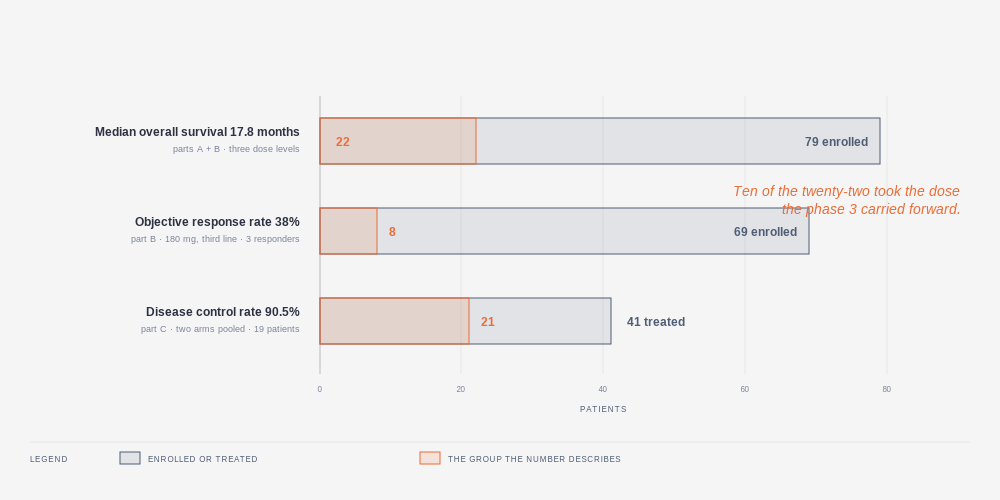
Parts A and B of THIO-101 are registered at N=10 and N=69. Seventy-nine patients enrolled. The 17.8-month median overall survival describes 22 of them: the third-line patients who received at least one dose, at a data cutoff of May 15, 2025.
Selecting by line of therapy is legitimate. Third-line patients are a real baseline category, not an outcome-defined group, and the Phase 3 enrols the same population. The problem is the dose.
Part A tested 360 mg per cycle. Part B randomised across 60 mg, 180 mg and 360 mg. The 22 patients in the survival figure span all of them, and MAIA has never published the split. What it has published is that the 180 mg third-line subgroup is 10 patients, with a progression-free survival of 5.6 months and a disease control rate of 77%. Subtract, and twelve of the twenty-two patients carrying the headline number were dosed at 60 or 360 mg per cycle: levels the programme abandoned.
THIO-104 gives every patient 180 mg per cycle. So the dose that went into the pivotal trial has a published PFS and a published disease control rate, and no published median overall survival at all. The number the thesis runs on belongs to a pool the Phase 3 does not reproduce.
The same shape repeats downward. The 38% objective response rate is three responders out of eight evaluable patients. The 90.5% disease control rate from Part C is 19 of 21 evaluable patients, where Part C had 41 patients treated internationally as of June 25, 2026, and randomises between ateganosine with cemiplimab and ateganosine alone. The July 8 release does not say which arm the 21 came from, and does not report an objective response rate at all, although the trial lists it as a primary endpoint. Disease control includes stable disease. It is the softest of the three measures, and it is the one that got the press release.
None of this says the drug does nothing. Eight patients past two years without a subsequent line of therapy is not noise in this population. It says the effect size the market is being asked to price has never been measured in the group the Phase 3 will measure.
The benchmark holds up, which is not the same as the comparison holding up
The obvious way to attack a three-times claim is to attack the denominator, so we went looking for a post-immunotherapy third-line series that beats five to six months. MAIA's benchmark survives the check. A retrospective series of 65 patients given docetaxel after progression on platinum chemotherapy and a checkpoint inhibitor reported a median overall survival of 6.0 months, with a 95% interval of 4.6 to 7.4. That is MAIA's number, in MAIA's setting.
The higher figures that turn up in the literature are second-line. Docetaxel with ramucirumab after first-line immunotherapy reached 11.1 months in a 2025 Current Oncology series, but 83.6% of those patients were on their second line, not their third. Borrowing a second-line survival curve to argue down a third-line benchmark would be the same error in the other direction.
So the benchmark is defensible. What is not defensible is the comparison built on it. The 22 patients were enrolled into a clinical trial, which means they met eligibility criteria on performance status, organ function and life expectancy that an unselected real-world third-line cohort does not. Trial populations outlive registry populations with the same diagnosis and the same prior lines, before any drug is given. That gap is not measurable from outside, and it is the entire reason a randomised control arm exists.
Geography adds to it. THIO-101 runs 40 sites across Poland, Hungary, Taiwan, Georgia, Bulgaria, Australia, Turkey and, since April 2026, two in the United States. The comparator literature is largely Western. Three times a benchmark drawn from a different health system, a different era and a different referral pattern is a hypothesis, not a result.
The enrolment pace and the dates attached to it
THIO-104 dosed its first patient on December 8, 2025. On June 4, 2026 MAIA announced 29 patients dosed across 34 activated sites in six countries outside the United States. That is 4.96 patients a month over 5.9 months.
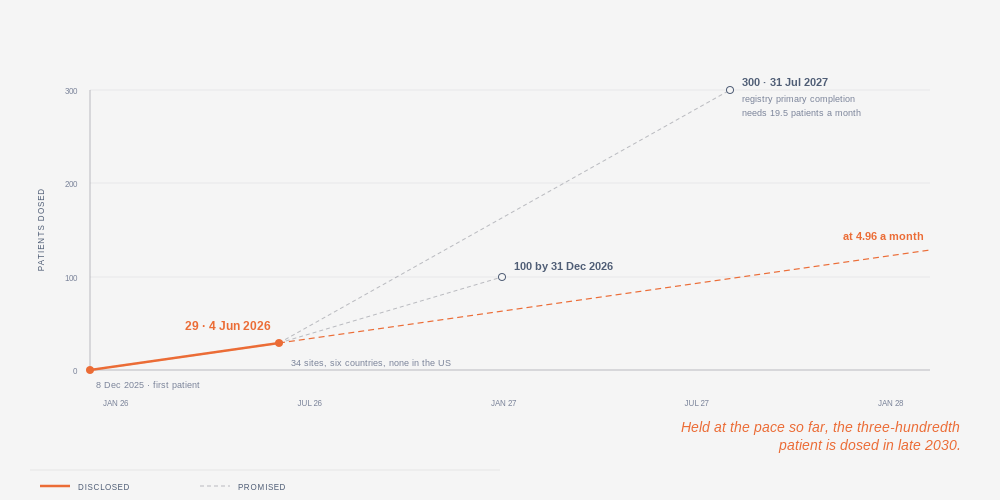
Management's target of up to 100 patients by the end of 2026 needs 10.3 a month from June, which is roughly double the pace achieved. The registry's own primary completion date of July 31, 2027 for 300 patients needs 19.5 a month, which is roughly four times. Held at 4.96, the hundredth patient arrives around the middle of 2027 and the three-hundredth some time in 2030.
u/Random-Redditor111 asked the right question in two lines: why is enrolment so slow if the market is very large? u/Resident-Area5907 gave the honest answer, that enrolment tracks the budget and MAIA has been adding sites in cheaper countries. That is correct and it is also the bear case. A trial whose pace is set by cash rather than by patient availability is a trial whose timeline moves with the financing.
An interim analysis is a softer requirement than full enrolment. Overall survival events accrue fast in third-line lung cancer, so an interim on a hundred patients is arithmetically reachable. Full enrolment on the registered schedule is not. The registry record was last updated on January 12, 2026 and still lists 15 sites in four countries, which is why the company's own 34-site figure is the one to use.
One further point about the same trial. Every activated site is outside the United States, and MAIA says in its S-3 that it plans to seek an accelerated approval filing in the United States during 2026. Three months of 2026 remain and no filing has been announced.
The trial that was fully funded took a million dollars from a trial funder
On April 8, 2026, MAIA announced that net proceeds from the March offering were expected to fully fund the ongoing Phase 3. The 10-Q repeats it. The same 10-Q says: "We will need to raise additional capital to fund our operations."
Then on August 29, 2026, MAIA signed a Clinical Trial Funding Agreement with PoC Capital, issuing 751,879 shares in a private placement. PoC agreed to provide $1,000,000 toward the cost of studies of ateganosine. On September 25 MAIA registered those shares for resale, which is how the agreement became public; there is no 8-K for it.
PoC Capital exists to pay for micro-cap clinical trials in exchange for stock the funder then sells. A million dollars is about six weeks of MAIA's burn. Taking it ten weeks after telling the market the trial was fully funded is the fact, and it is a small fact carrying a large implication about the cash position.
The burn is also accelerating:
| Line | Q1 2026 | Q2 2026 | H1 2026 |
|---|---|---|---|
| Operating cash used | $5.31M | $6.75M | $12.06M |
| R&D expense | $3.53M | $5.64M | $9.16M |
| G&A expense | $3.42M | $2.68M | $6.10M |
| Stock compensation | $0.65M | $0.72M | $1.37M |
| Cash at period end | $34.4M | $27.6M | $27.6M |
In the comments the author puts runway at about 14 months, from $27.6 million of cash against $12.1 million of half-year burn. That uses the half-year average. Q2 alone ran at $6.75 million, which annualises to $27 million and puts the money out around the middle of 2027, before the Phase 3 spends more as sites open.
The obvious defence is that this is non-cash compensation inflating the expense lines. It is not. R&D rose 45% year on year and G&A rose 43%, while stock compensation rose 17%. The money is leaving. It is a company spending faster on a trial enrolling slower.
Against that: the August 21 S-3 registers a $150 million universal shelf and carries forward $94.0 million of unsold capacity from the 2023 shelf, for $244.0 million of registered capacity. The post calls it a $150 million shelf. It is $244 million, against a market capitalisation of roughly $71 million at the September 29 close of $1.15.
What the insiders were handed in the same week they bought
The buying is real and it continued after the post went up. Vitoc bought 73,000 shares at $1.37 on September 14. Director Ramiro Guerrero bought roughly 185,000 shares across late August and September 10. Across eleven months, five officers and directors bought 603,963 shares on the open market and paid about $766,000 for them. That is their own money and it deserves to be counted.
Count the other side too.
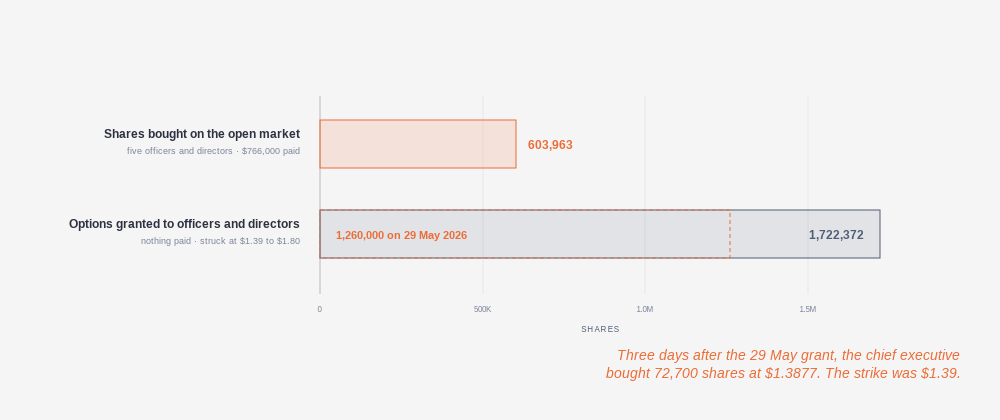
Over the same eleven months the same group was granted 1,722,372 stock options. The purchases are 35% of the grants and the grants cost nothing. The timing is the part worth sitting with: on May 29, 2026 the board granted Vitoc 800,000 options, chief scientific officer Sergei Gryaznov 400,000 and head of finance Jeffrey Himmelreich 60,000, all struck at $1.39. Three days later, on June 1, Vitoc bought 72,700 shares at an average of $1.3877 and director Stan Smith bought 75,000 at $1.336. Each spent almost exactly $100,000.
Two round six-figure purchases at the strike price of a grant dated three days earlier is a signal, but it is not the signal the post reads it as. The company-wide number makes the scale plain: options outstanding went from 12,878,381 at the end of 2025 to 16,680,425 at June 30, with 4,223,523 granted in the half. That is 7% of the share count issued to employees in six months.
Fully diluted, the company is 61.7 million shares plus 13.1 million warrants at a weighted average strike of $1.92 plus 16.7 million options at $2.00, or about 91.5 million. Nearly all of it is struck above today's $1.15, so it dilutes only on good news, which is the honest version of the overhang.
The filing says a licensing deal is not probable
The post treats the Regeneron, Roche and BeOne supply agreements as evidence that ateganosine has partner interest and that MAIA keeps its optionality. Two corrections, both from the filings.
The Regeneron agreement is not free of rights. MAIA's own language: in return for cemiplimab at no cost, "we have granted Regeneron exclusive development rights in combination with PD-1 inhibitors for NSCLC for the study period." Worldwide commercial rights to ateganosine are retained. Development rights in the combination that defines the programme are not entirely.
The second is sharper. MAIA has granted 400,000 performance-based options to a strategic advisor at $1.49. Tranche 1, 100,000 options, vests on completing a new or modified supply and non-exclusive licence agreement. Tranche 2, 300,000 options, vests on any agreement giving a third party licence rights to MAIA's intellectual property, or on raising more than $10 million from an investor in exchange for a royalty or more than 5% of the fully diluted share count.
A company that pays a finder in contingent equity to produce a licence is a company that does not have one in hand. And in the June 30 accounts, MAIA recognised no expense on either tranche, because it determined that achieving Tranche 1 and Tranche 2 "were not probable." Management's own assessment, filed in August, is that neither a licence nor a large strategic financing is probable. That is the thing the acquisition thesis has to argue against, and it is in the same document as the numbers the thesis quotes.
Two things the thread never discussed
u/dorsei posted a bare link to a press release and nobody replied to it. The release, from October 7, 2025, announces that MAIA's board authorised holding up to 90% of the company's liquid assets in Bitcoin, Ether and USD Coin, with a Digital Assets Advisory Board to be established. At the time MAIA held $10.9 million of cash against an $18.8 million annual burn.
No purchases were made. The Q2 2026 10-Q reports the plan as adopted, unexecuted, and "currently on hold" because of cryptocurrency volatility. On hold is not rescinded. Five months after the board passed it, MAIA raised $33 million from investors on the basis that the money funds a Phase 3 cancer trial, and the authorisation permitting most of that money to be moved into Bitcoin is still live in the filings.
The second omission is the banker. On April 22, 2026, H.C. Wainwright sued MAIA in the Supreme Court of the State of New York, claiming breach of a right of first refusal in its engagement agreement when MAIA ran the March offering through Konik Capital Partners instead. Wainwright wants $2,310,616.88 in cash plus warrants for 1,540,411 shares at $1.875. MAIA moved to dismiss on June 26 and says it cannot predict the outcome. On May 14 MAIA terminated the Wainwright at-the-market facility outright.
The claim is about 7% of the gross proceeds of the offering the thesis depends on, which is not a solvency event, but it does mean the company changed bankers in the middle of its largest financing and is now being sued over the fee by the bank that ran its ATM for two years.
Scoring the thread
u/DieOnYourFeat's argument that no biotech specialist owns the stock was the most useful comment, and it was overstated. u/bptbay was right to narrow it: Solas Capital Management reported 3,030,845 shares, exactly 4.9%, as of June 30, 2026. One 13G, stopped deliberately below the 5% line, is a long way from a Baker Brothers position, and also a long way from "they have all passed." u/DieOnYourFeat conceded the point cleanly, which is rarer than either of them being right.
u/Appolon_2027 relayed management's claim of a 90% probability of success at interim and 96% at the end of Phase 3, and said in the same breath that the Bayesian models behind those numbers had not been seen or audited. A 90% probability of success on a pivotal oncology trial is not a number any outsider should carry forward, and the person quoting it said so.
u/Resident-Area5907 disclosed having worked in the Shay Lab where the ateganosine preclinical work was done, named their own confirmation bias, and then made the most concrete contribution in the thread by explaining that enrolment is budget-constrained. Disclosure of that quality is worth more than most of the analysis above it.
The argument nobody in the thread made is the one the filings make. Not that the science is wrong, but that the headline efficacy number was generated at doses the pivotal trial dropped, and that the company's own August filings say the trial is being funded a million dollars at a time and a licence is not probable.
Where we land
The mechanism is real, the preclinical work is published, Fast Track is granted, and the survival signal in a heavily pretreated population is not nothing. Eight patients past two years without another line of therapy is a fact worth having.
What does not survive is the specific number the thesis is built on. The 17.8 months belongs to 22 patients of 79 enrolled, across three dose levels, twelve of whom took doses the Phase 3 abandoned, and it is measured against a real-world benchmark by a trial-eligible population. The benchmark itself checks out at 6.0 months. The dose that matters has no published median survival at all.
What also does not survive is "fully funded." A company with a funded pivotal trial does not sell shares to a clinical trial funder for a million dollars in August, and does not register $244 million of shelf capacity in the same month.
Three things would move this, and all of them are narrow. Whether MAIA publishes a median overall survival for the 180 mg third-line cohort, which it could do at any conference and has not. The next enrolment update on THIO-104, and specifically whether the monthly pace moves off 4.96. And the Q3 10-Q, for the cash number and for whether the digital asset treasury plan is still described as on hold rather than rescinded.
The thesis is not that this is a fraud. It is that a $71 million valuation for a drug with a plausible mechanism and an unmeasured effect size at the pivotal dose is not obviously cheap, and that the asymmetry the post describes is smaller than it looks in both directions.
Not investment advice. We hold no position.
Sources
- u/SecondPrevious7385's DD on r/biotech_stocks, plus comments from u/DieOnYourFeat, u/bptbay, u/dorsei, u/Random-Redditor111, u/Resident-Area5907 and u/Appolon_2027
- MAIA Q2 2026 Form 10-Q (cash, burn, warrants, options, Wainwright action, digital asset plan, strategic advisor options)
- MAIA Form S-3, September 25, 2026 (PoC Capital Clinical Trial Funding Agreement, share count, Regeneron development rights)
- MAIA Form S-3, August 21, 2026 (the $150M shelf plus $94.0M carried forward)
- MAIA prospectus supplement terminating the Wainwright ATM, May 14, 2026
- MAIA Form 4 filings (every purchase and grant counted above)
- THIO-104, NCT06908304 (start date, 300-patient target, July 2027 primary completion, site list)
- THIO-101, NCT05208944 (Part A N=10, Part B N=69, dose levels, 40 sites)
- MAIA efficacy update, June 5, 2025 (17.8 months, n=22, May 15 2025 cutoff)
- MAIA Part C initial efficacy, July 8, 2026 (19 of 21, no ORR reported)
- MAIA completes international enrolment in Part C, June 25, 2026 (41 patients treated)
- MAIA digital asset treasury announcement, October 7, 2025
- Solas Capital Management Schedule 13G/A
- Docetaxel after platinum and immunotherapy, ASCO 2023 abstract e21197 (65 patients, median OS 6.0 months)
- Docetaxel and ramucirumab after first-line immunotherapy, Current Oncology 2025 (median OS 11.1 months, 83.6% second line)
Discussion
Nobody has replied yet. If the argument here is wrong, say so.