Source: a scientist appreciation thread on r/biotech_stocks by u/DeepDivesnGoodMusic, late July 2026, plus the pinned resource hub in r/sellaslifesciences by u/Ramuh321. The thread lists five researchers attached to SELLAS Life Sciences and treats the list as evidence. Those credentials are real and we have checked them. The recomputations of the trial's statistics are ours, and every input points at the published protocol, a filing, or a journal.
The claim
The thread argues in three steps. SELLAS has a network of contributors far more impressive than outsiders assume. A short seller's sockpuppets have attacked the CEO while never mentioning anyone else. Therefore the bear case, which the OP summarises as the claim that SELLAS is a scam, collapses.
The five named are Larry W. Kwak of City of Hope, David A. Scheinberg of Memorial Sloan Kettering, Linghua Wang of MD Anderson, Panagiotis Tsirigotis of the National and Kapodistrian University of Athens, and Alex Kentsis of MSK. The OP suggests readers ask an AI to list each person's accomplishments, and several passages are labelled "From A.I.".
The credentials check out. Kwak was named to TIME's 100 most influential people in 2010 for his work on therapeutic cancer vaccines. Scheinberg invented galinpepimut-S, which SELLAS licenses from MSK. Wang is a tenured associate professor in Genomic Medicine at MD Anderson. Tsirigotis is the highest enroller in the Phase 3 trial. Kentsis founded the MSK Tow Center for Developmental Oncology.
None of it is in dispute, and none of it is what the bear case says.
Everyone on the list has a paid relationship with SELLAS
The thread presents the five as an independently impressive network the OP happened to discover. Each has a compensated relationship with the company, disclosed by the company:
| Person | Relationship | Since |
|---|---|---|
| David A. Scheinberg | Director, chairs the board's Science Committee | SAB 2015 to 2017, then the board |
| Larry W. Kwak | Scientific Advisory Board | November 11, 2015 |
| Alex Kentsis | Scientific Advisory Board | June 5, 2025 |
| Linghua Wang | Scientific Advisory Board | July 7, 2025 |
| Panagiotis Tsirigotis | REGAL site investigator, highest enroller | trial opened February 2021 |
Nothing here is improper. Companies recruit advisory boards because good ones are worth paying for, and every relationship was announced in a press release. The Wang release says it outright: "Dr. Wang receives compensation as a member of SELLAS's Scientific Advisory Board, and this financial relationship has been disclosed to MD Anderson's Conflict of Interest Committee in accordance with institutional policy." The 2018 Blood Advances paper on the Phase 2 keeps the same discipline: "D.A.S. is inventor of the vaccine and a consultant to Sellas."
The problem is what the list is used for. A paid advisory board is not outside confirmation of a company's science. It is the company's own science, staffed well. The disclosures the argument needed were sitting in the sources the thread pointed at. The single source the OP links for Kentsis, a Mount Sinai alumni Zoom call, never mentions SELLAS, WT1 or galinpepimut. It is a good conversation about being a physician scientist, and it is not evidence about a drug.
The bear case was never that the science is fake
One commenter said so plainly and sat at minus three votes for it:
You need to connect these people to what they're actually doing at Sellas or in the trial. Nobody thinks the science is fake. MSK is certainly legitimate. People think it doesn't work.
That is the whole disagreement. WT1 is a real target, ranked top of a National Cancer Institute consensus list of cancer antigens. Scheinberg really did design the peptide. Whether a multivalent peptide vaccine plus GM-CSF extends survival in adults whose acute myeloid leukaemia has relapsed once and who cannot have a transplant is a separate question, and credentials do not answer it. A hazard ratio does.
The published evidence behind galinpepimut-S in AML is one single-arm Phase 2 in 22 patients, run in first complete remission rather than second. Median disease-free survival from CR1 was 16.9 months, 15 of 22 patients relapsed, and 9 of 14 tested mounted an immune response. The survival figure that travels from that paper, 67.6 months or longer, was measured from diagnosis, in a single arm, with no comparator. REGAL measures survival from randomisation, in second remission, against a control. The two numbers are not on the same axis, and the bigger one is not the more relevant one.
The immune response figure deserves the same scrutiny. Of the 9 enrolled patients who were HLA-A*02:01 positive, the genotype needed for two of the vaccine's four peptides to activate CD8+ killer T-cells, 7 were tested and 6 showed a positive CD8+ response. Comparing immunologic responders to non-responders across the trial, survival curves separated but not significantly in a cohort this small: DFS p = .11, OS p = .08. One patient who did mount a confirmed CD8+ response relapsed anyway, which the paper attributes to possibly inadequate vaccine dose or duration rather than to CD8+ activation being sufficient on its own.
The CR2 evidence, which is the setting REGAL actually tests, is thinner still. The published version sits in the protocol paper co-authored by SELLAS's own chief development officer: an ad hoc analysis of a 14-patient Phase 1, comparing 10 CR2 patients who received more than two doses of galinpepimut-S against 15 contemporaneously treated historical matched controls. Median overall survival was 16.3 months against 5.4, p = 0.0175. Median progression-free survival was 10.5 months against 4.3, p = 0.19, which is not significant. On the November 2022 call the CEO put the same comparison at 21 months against 5.4. The control figure matches the publication and the galinpepimut-S figure does not, so the 21 months stays attributed to him.
What 0.636 actually is
The number both communities treat as the trial's goal is its pass mark. This is the most consequential misreading in the discussion.
The published protocol states the design in one sentence: "Approximately 125–140 patients will enroll, in a 1:1 ratio, to provide at least 90% power under an assumed hazard ratio of 0.636, based on median OS of 8.0 m (BAT) and 12.6 m (GPS). The planned number of deaths for the study is 80." Testing is one-sided at 0.025, with one interim at 60 deaths and a Lan-DeMets O'Brien-Fleming spending function.
Start with what 0.636 is, because the answer is in the record. On the November 2022 call that introduced the number, the CEO described a threshold rather than an expectation: "statistical significance would be achieved by an estimated hazard ratio for overall survival of 0.636." A pass mark is a function of the event count, so it can be reconstructed. For a log-rank test the observed hazard ratio clears significance when |ln HR| exceeds 2z / √D, where D is the number of deaths. A single critical value of z = 2.013, roughly what an O'Brien-Fleming interim leaves of a one-sided 0.025, reproduces both hazard ratios the company has ever quoted:
| Design | Deaths at final analysis | Company's stated HR | Boundary at z = 2.013 |
|---|---|---|---|
| Original SAP | 105 | 0.675 | 0.675 |
| Revised SAP, October 2022 | 80 | 0.636 | 0.638 |
Two designs, two thresholds, one boundary, reproduced to three decimals. 0.636 is not what galinpepimut-S is expected to do. It is the mark it has to hit.
That makes the power claim hard to hold. Power against a boundary is Φ(|ln HR| √(D/4) − z), so at 80 deaths:
| If the true hazard ratio is | Power |
|---|---|
| 0.675 | 40% |
| 0.636 | 50% |
| 0.48 | 90% |
| 0.37 | 99% |
Reaching 90% power against a true hazard ratio of 0.636 would take 212 deaths, not 80. At 80 deaths, 90% power arrives only if the true effect is near 0.48. At the stated 0.636 the trial is a coin flip by construction, because a design whose assumed effect equals its own critical value has 50% power.
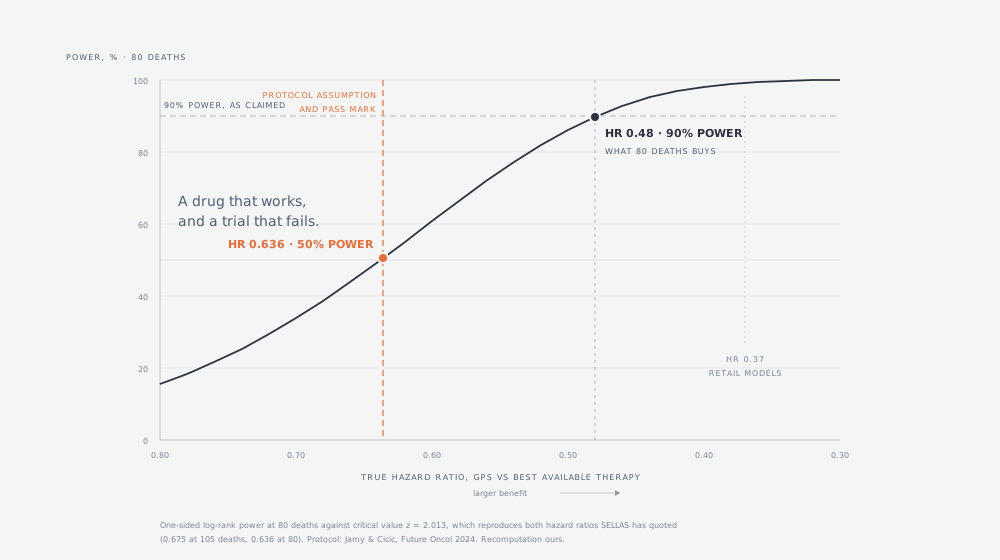
Before resting on that, the defence. Three things could reconcile a 90% power claim with 80 deaths. The paper could be compressing two quantities, an effect size used for sizing and a boundary used for testing, into one number. The power could rest on an accrual and follow-up model rather than on events alone. Or the design could anticipate non-proportional hazards, curves that separate late and then plateau, for which an event-count formula understates power. The third is the live one, and a contributor in r/sellaslifesciences reaches for it directly, putting the plateau case near 0.46.
It does not close the gap, because the protocol names its own primary analysis: a stratified Cox proportional hazards model, treatment as the only independent variable, testing H0: HR ≥ 1. A Cox model returns one hazard ratio and assumes it is constant. If the real curves plateau, the trial still has to win on the proportional-hazards test the protocol commits to, and the mark that test clears at 80 deaths is the one above. A plateau changes what the drug is doing. It does not change the arithmetic of the test.
This reframes rather than refutes the community's modelling. The numbers people in r/sellaslifesciences converge on cluster around 0.37, which looks like optimism until you compute the boundary, at which point it looks like a requirement. A modest real benefit, 0.75 say, is a drug that works and a trial that fails.
Why the events slowed, and what that cannot tell you
The trial's history is survival outrunning its own assumptions. The original plan assumed a pooled median overall survival near 8 months. In October 2022, after reviewing pooled blinded data, SELLAS submitted a revised plan to the FDA: interim cut from 80 deaths to 60, final cut from 105 to 80, enrollment raised from 116 patients to between 125 and 140, and the pooled median assumption raised to 12.5 months. The stated reason was that patients were "collectively experiencing a longer than originally expected overall survival duration."
Survival kept outrunning it. Enrollment closed in March 2024 at 127 patients. The pooled death count reached 60 in December 2024, 72 by December 26, 2025, and 78 by May 11, 2026. As of the August 11, 2026 filing the 80th has not occurred, twenty-nine months after the last patient was randomised, in a population the design expected to reach a median of 12.5 months.
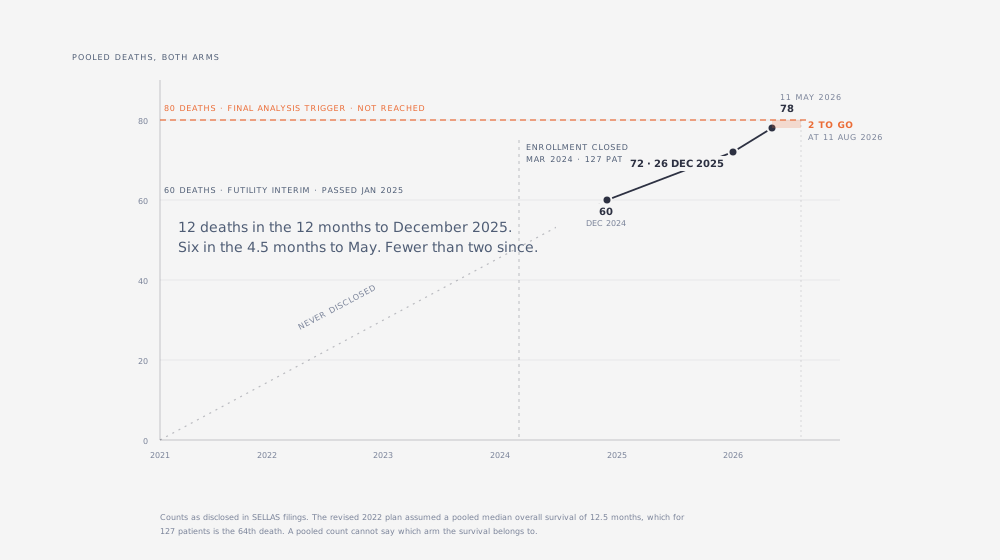
Those three counts are the entire public record of how this trial is going, and the pace inside them is worth reading. Twelve deaths arrived in the twelve months to December 2025, six more in the four and a half months to May, and fewer than two in the three months since. The final analysis is event driven, so the readout date is a function of that pace and nothing else.
Two readings survive it and the pooled count cannot separate them. Either the galinpepimut-S arm is living far longer than 12.6 months, or the best available therapy arm is living far longer than 8.0 months. A pooled death count is arm-agnostic by construction. It is the one number that carries no information about which arm produced it.
The best analytical work in either community is u/Next_Degree's argument against a strong control arm: that roughly a quarter of best available therapy is observation, hydroxyurea or palliative care, that relapsed and refractory AML runs to 6 to 8 months of median survival, and that the elapsed time is hard to reconcile with that. It is careful, it flags its own uncertainty, and it asks the right question.
It also leaves out a third explanation. The entry criteria select for survivors. A patient must be in second complete remission, be consented within six months of achieving it, be ineligible for transplant, carry more than 300 lymphocytes per microlitre, and meet the performance status requirement. A cohort assembled that way outlives the registry averages used to model it, in both arms, before any drug does anything. Slow events are what a heavily selected cohort looks like.
One correction, offered in the spirit it was written. u/Low-Childhood-748 argued that outside modelling cannot identify which arm is driving event deceleration because "REGAL tx assignment is blinded." The conclusion is right and the mechanism is wrong. REGAL is open-label, in the protocol and in every 10-Q: patients and investigators know their assignment. What is blinded is the sponsor, and through it everyone outside. The August 2026 filing puts it exactly: "We remain blinded to all efficacy and survival data outcomes."
The base rate is in this company's own history
A second commenter asked the question that would have tested the thread's logic and got no reply: "So, the biotech stocks that fail, they don't usually have scientists with top credentials?" The answer is in the filings.
SELLAS files under CIK 1390478. So did Galena Biopharma, which held that CIK from 2011 to 2017, and RXi Pharmaceuticals before that. One continuous registrant. Galena's lead asset was NeuVax, an HLA-restricted peptide cancer vaccine given with GM-CSF and backed by academic investigators of real standing. On June 27, 2016 the data monitoring committee recommended stopping its Phase 3 for futility after reviewing 71 events in 758 patients, and the stock fell more than 80% to $0.39.
NeuVax did not stop being this company's problem when Galena became SELLAS in the 2017 merger, a point a July 2026 bear thesis by Franciszek Kessler makes in more detail than any reddit thread has. Renamed nelipepimut-S, it went into VADIS, an NCI-sponsored Phase 2 in ductal carcinoma in situ that SELLAS supplied and press-released through 2019 and 2020, before the program stopped advancing toward another pivotal trial. A second peptide-plus-GM-CSF vaccine from the same company, on the same adjuvant platform, generated encouraging early data and did not reach a second registrational trial. That is not a different company's history sitting under a shared CIK. It is this one's own second attempt.
Widen the lens further and the pattern belongs to the modality, not only to this company. Independent tallies of synthetic peptide vaccines against tumour-associated antigens, the class GPS belongs to, count more than 125 candidates that reached Phase 1 and about 30 that reached Phase 2. None has cleared Phase 3 into an approval. WT1 ranking top of the NCI's target list has not been the constraint. Getting a TAA peptide vaccine through a pivotal trial has.
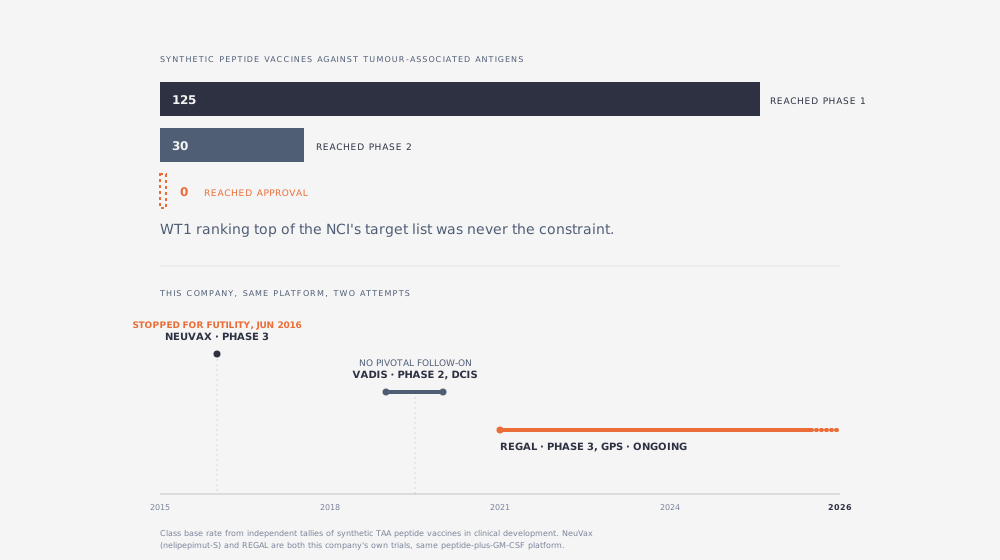
That comparison cuts the other way too: PRESENT failed its futility interim and REGAL passed its own. The 60-death threshold was reached in December 2024, and in January 2025 the IDMC recommended the study continue without modifications. Clearing futility is a better position than not clearing it. It is not the same as winning.
The closer precedent is on the CEO's curriculum vitae. Angelos Stergiou "led the Phase 3 development of a therapeutic cancer vaccine, BiovaxID, into completion which was presented at the American Society of Clinical Oncology plenary session in 2009, and also holds a patent on the technology." BiovaxID was a patient-specific idiotype vaccine for follicular lymphoma given with GM-CSF. Its Phase 3 was published in the Journal of Clinical Oncology in 2011, and the last author is Larry W. Kwak.
That trial had two co-primary disease-free survival endpoints. Across all 177 randomised patients it missed: median DFS 23.0 months against 20.6, HR 0.81, 95% CI 0.56–1.16, P = .256. Across the 117 who received at least one dose it hit, barely: 44.2 months against 30.6, HR 0.62, 95% CI 0.39–0.99, P = .047. The significant result then rested further on an unplanned subgroup split by vaccine isotype, IgM at P = .001 and IgG at P = .807. The authors' conclusion is hedged to match: the vaccine "may prolong DFS." BiovaxID is not an approved product in the United States.
So the closest available comparable produced a hazard ratio of 0.62 in its most favourable analysis set, better than the 0.64 REGAL has to clear, and it was not enough. Both communities model the sequence as 80th death, then a hazard ratio, then a $10 billion acquisition. A statistically positive Phase 3 in a therapeutic cancer vaccine is not the same object as an approvable BLA.
What doesn't hold up, and one thing that does
u/Yung_Ceejay in r/biotech_stocks cites OCV-501, another WT1 peptide vaccine, as proof that WT1 immunogenicity prolongs survival, linking a paper indexed at PMID 37093243. That paper is a follow-up analysis of a randomised Phase 2 trial in 133 elderly AML patients, 69 on OCV-501 and 65 on placebo. The randomised comparison, the part of the trial that isolates the vaccine's own effect, found no benefit: five year disease-free survival was 36.0% on OCV-501 against 33.7% on placebo, p = .74. Patients whose antibody response was strongest did live longer than weak responders, p = .004, but the same paper explains why that is not evidence for the vaccine: responsiveness likely "reflects general immune functions in AML patients," and patients who retain those functions may have a better prognosis "irrespective the vaccine effect." Healthier patients respond better to vaccines and live longer for reasons that have nothing to do with the vaccine, and the cited paper says so in the same paragraph the citation comes from. It is the strongest available randomised test of the general premise behind the citation, and on that test the premise did not hold.
The one document worth citing is Franciszek Kessler's "Why I Believe the REGAL Trial Will Fail and SLS Will Crash," posted to GitHub in July 2026 with a companion valuation model. Its two sharpest points are already folded into the sections above: NeuVax as this company's own prior failure on the same platform, not a different company's history, and the valuation floor below.
Is this ABVX, and does it 10x?
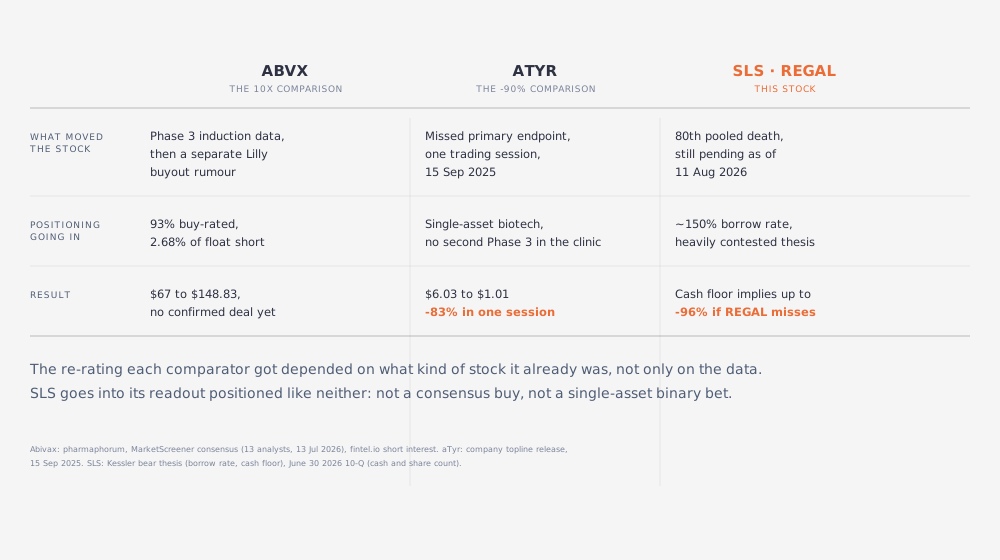
u/JamesIIIVVVV's post in r/biotech_stocks asks readers to imagine SLS repeating Abivax's run to a peak of $148.83 once REGAL reads out. u/Zipski577 has the correction: Abivax's Phase 3 induction data in July 2025 moved the stock into roughly the $60 to $90 range, and the run to $148.83 came later, on reports from the French outlet La Lettre that Eli Lilly was circling, reports the company never confirmed. Abivax entered that second leg already a consensus name: thirteen sell-side analysts on a buy rating, an average one-year price target of $181, and only 2.68% of its float sold short. SLS is close to the opposite kind of stock. Kessler's thesis puts its borrow rate near 150%, evidence of how much of the float is already sold short against it. A re-rating on takeover speculation needs a market that already agrees on the target. Abivax had that market before its second leg up. Whether SLS does is a separate question from whether REGAL reads out well.
Is this ATYR, and does it lose 90%?
aTyr Pharma is the other name these threads keep reaching for. On September 15, 2025, its Phase 3 EFZO-FIT trial in pulmonary sarcoidosis missed its primary endpoint, a steroid dose reduction of 2.79 mg on efzofitimod against 3.52 mg on placebo, p = .33, and the stock fell from $6.03 to $1.01 in a single session, an 83% drop. Secondary measures moved in the drug's favour, 52.6% of patients came off steroids entirely against 40.2% on placebo, but a positive secondary trend attached to a missed primary endpoint bought aTyr nothing.
One structural difference matters. REGAL's primary endpoint, overall survival, is binary: a patient is alive or dead, with no dose-response curve to read hopefully after the fact the way aTyr's steroid measure allowed. But that does not remove the coin-flip risk this piece has already computed. It only removes the ambiguity about what failure looks like. A hazard ratio that misses 0.636 is exactly as final as aTyr's p = .33, and GPS's own CR2 data already carries the same pattern aTyr's did: a positive-looking secondary measure, progression-free survival at p = .19, that did not reach significance either. Kessler's cash floor, cash alone at $138.3 million across 201.9 million shares, is $0.68 a share against $15.46, a bigger drop than aTyr investors actually took if REGAL misses the way EFZO-FIT did.
What the market is paying
At 201,945,709 shares outstanding as of August 10, 2026 and a $15.46 close on August 21, SELLAS is a $3.12 billion company. Against that:
| Line | Value |
|---|---|
| Cash and equivalents, June 30, 2026 | $138.3M |
| H1 2026 operating cash use | $16.4M |
| H1 2026 proceeds from warrant exercise | $82.9M, on 48.8M warrants at $1.70 average |
| R&D, H1 2026 | $11.4M |
| G&A, H1 2026 | $8.5M |
| Unused ATM capacity, filed March 2026 | $150.0M |
| Revenue | none |
The balance sheet is the strongest in the company's history and the dilution that built it has happened. Shares went from 15.9 million at the end of 2021 to 201.9 million now, but the $82.9 million raised in the first half of 2026 came from warrant holders exercising at $1.70 rather than a discounted placement, and what remains is small: 9.7 million warrants, 2.6 million options and 3.3 million restricted stock units, about 7.8% of the count, down from 69.0 million warrants a year earlier. Cash covers more than twelve months with no going-concern qualification. This is not a company about to run out of money, and the unused $150 million ATM is the forward risk rather than a past injury.
The buyout arithmetic is where the price is hardest to defend, and there is an approved comparator to test it against. Onureg, azacitidine in tablet form, was approved in September 2020 for continued treatment of adults with AML in first complete remission after intensive induction who cannot complete intensive curative therapy. Its pivotal trial, QUAZAR AML-001, randomised 472 patients aged 55 and over who were not candidates for stem-cell transplantation, and reported median overall survival of 24.7 months against 14.8 on placebo, hazard ratio 0.69.
Two things follow, and the first is about the boundary again. Onureg won with a hazard ratio of 0.69, which is worse than the 0.64 REGAL must clear, because 472 patients generate enough events to make 0.69 significant. A drug with exactly Onureg's effect would fail REGAL about two times in three. The mark is a function of how big the trial is, not of how good the drug is.
The second is commercial. Onureg sits one line earlier in a larger population than REGAL's, and five years after approval Bristol Myers Squibb does not report it separately. It is inside an "Other Growth products" line that also carries Augtyro, Inrebic, Nulojix, Empliciti and royalty revenue, and that entire line was $1,924 million in 2025. The approved drug in the bigger neighbouring indication is not individually material to its owner.
Set the community's numbers against that. The resource hub reports projections clustering at $10 billion to $20 billion, quoted as $44 to $88 per share; on the latest share count those figures are $49.52 and $99.04. SELLAS's own 10-K cites a DelveInsight estimate putting the entire global AML market at $5.09 billion by 2030. The low end of the range therefore asks a buyer to pay twice the whole projected global market for this disease, for one asset in a subset of it. The high end asks for nearly four times. Getting there needs the label expansions the company names as ambitions, first-remission and post-transplant maintenance, neither of which has a randomised trial behind it, which makes it a bet on the second and third indications priced before the first has read out.
What the stock has been repricing is the event count, not the science. On May 12, 2026 the Q1 filing disclosed 78 deaths as of May 11. The next day SLS closed up 25%, from $5.22 to $6.53. It reached $15.45 on June 29, then drifted to $10.09 by the day the appreciation thread posted, $12.78 by August 14, and $15.46 by August 21, back near its June high. Nothing about anyone's curriculum vitae moved in that window.
One thing the thread landed on top of. On July 27, the day before it posted, SELLAS disclosed that the sole arbitrator at the Hong Kong International Arbitration Centre had dismissed its claims against its Greater China licensee, 3D Medicines, and allocated roughly $1.0 million of 3D Medicines' costs to it. Neither the thread nor the resource hub mentions it. Financially it is small: the licence survives with $191.5 million of potential milestones outstanding, including the disputed $13.0 million. Its lasting consequence is geographic. Mainland China enrolled nobody, so a trial planned for approximately 95 sites finished with 127 patients across 73, of which 17 are in the United States and 10 in Greece, home of the highest enroller.
Kessler's bear thesis prices the drug from the bottom up. Of roughly 20,000 new US AML cases a year, a minority reach second remission, are transplant ineligible, and match REGAL's other entry criteria: 1,000 to 2,000 US patients a year, 3,000 to 4,500 globally at steady state. At an orphan-drug price comparable to venetoclax or gilteritinib, $150,000 to $200,000 a year, that implies realistic peak sales of $150 million to $450 million against an enterprise value near $2.98 billion, pre-readout. The downside case, what that gap means if REGAL misses, is below.
Scoring the thread
The OP wrote something generous. Giving a human face to the people behind a drug is a decent instinct, the post is polite to its critics, and the resource hub is one of the better retail compilations we have read: it links the peer-reviewed protocol, the registry, the filings and the critical arguments, and labels user models as user models. That is more epistemic hygiene than most single-ticker communities manage.
It is still an argument that cannot work, and its own method shows why. The credentials were assembled by asking Gemini and presented as "From A.I.", while further down the same thread a commenter correctly explains that language models cannot model the trial because the patient-level data is not public. Both are true. Neither an AI summary of a CV nor an AI simulation of a survival curve tells you the hazard ratio.
Who was right. u/Latter-Ad9256 identified the actual disagreement in four sentences and finished at minus three. u/Delicious_Worth_5875 asked the only question that would have tested the thread's logic and was ignored. u/Low-Childhood-748 got the substance of the inference problem right while using the wrong word for it. u/Next_Degree wrote the best analysis in either subreddit and correctly refused to draw a conclusion from it. u/Zipski577 pointed at the CEO's earlier tenure at Anavex, which is on the CV without a date or title and carries no weight; the entry worth reading was BiovaxID, two lines further down.
The argument nobody made: that 0.636 is a pass mark rather than a target, that the mark got harder in October 2022 when the event count fell from 105 to 80, and that the protocol therefore describes a coin flip. The company said reducing the events preserved the study's sensitivity. It reduced it, by about 12 points of power at a true hazard ratio of 0.636 and 6 points at 0.48.
Where we land
The science is real, the advisors are real, and neither is evidence about the readout. The list of names is a list of people SELLAS pays, which is normal, disclosed, and not independent corroboration.
What decides this company is one number arriving within months. REGAL needs an observed hazard ratio near 0.64 or better on 80 deaths. If galinpepimut-S performs exactly as the protocol assumed, the trial succeeds about half the time. That is not a comment on the drug but on a design whose assumed effect equals its critical value, and it is why the community's talk of 0.37 reads better as a requirement than a hope. Clearing the mark is also necessary rather than sufficient: BiovaxID cleared 0.62 and never reached the market.
Two dates rather than opinions. The 80th death, which the company has committed to announcing when it occurs and which stood two away in May. And the $150 million ATM, unused since March, the mechanism by which a good result gets monetised and a bad one survived.
The bear case worth arguing with was never that anyone is faking it. It is that a 127-patient open-label trial resolving on 80 deaths, with a boundary at 0.64 and a pooled survival curve that has twice outrun its design without saying which arm did the outrunning, is less certain than $3.12 billion implies. Nobody in the appreciation thread had to answer that, because nobody in it raised it.
The threads and the thesis that followed publication sharpen rather than overturn that case. The best new bull argument, that OCV-501 proves WT1 immunogenicity translates to survival, reads the opposite of its own citation. The best new bear argument, that this company already ran this exact experiment on a different antigen and watched it fail a futility review, is a second and independent line of evidence pointing the same direction as the 0.636 boundary.
Not investment advice. We hold no position.
Sources
- u/DeepDivesnGoodMusic's scientist appreciation thread, r/biotech_stocks, plus comments from u/Latter-Ad9256, u/Delicious_Worth_5875, u/Low-Childhood-748 and u/Zipski577
- The SLS resource hub, r/sellaslifesciences, by u/Ramuh321, including u/Next_Degree's super BAT writeup and u/YogurtclosetFar3427's event reconstruction
- Jamy O, Cicic D. REGAL: galinpepimut-S vs. best available therapy as maintenance therapy for acute myeloid leukemia in second remission. Future Oncol. 2024;21(1):73-81
- REGAL update call transcript, November 2022, 8-K exhibit 99.1 (the 105 to 80 event change)
- SELLAS Q2 2026 Form 10-Q, filed August 11, 2026
- SELLAS FY2025 Form 10-K, filed March 19, 2026
- SELLAS 8-K, July 27, 2026: 3D Medicines arbitration dismissed
- Maslak PG et al. Phase 2 trial of a multivalent WT1 peptide vaccine (galinpepimut-S) in acute myeloid leukemia. Blood Adv. 2018;2(3):224-234
- Schuster SJ et al. Vaccination with patient-specific tumor-derived antigen in first remission improves disease-free survival in follicular lymphoma. J Clin Oncol. 2011;29(20):2787-94 (the BiovaxID Phase 3, last author L.W. Kwak)
- Angelos Stergiou curriculum vitae
- Wei AH et al. Oral azacitidine maintenance therapy for acute myeloid leukemia in first remission. N Engl J Med. 2020;383(26):2526-37 (QUAZAR AML-001, 472 patients)
- FDA approves Onureg as continued treatment for adults in first remission with AML, September 1, 2020 (hazard ratio 0.69)
- Bristol Myers Squibb FY2025 Form 10-K (Onureg inside the $1,924M Other Growth products line)
- ClinicalTrials.gov NCT04229979, REGAL
- Galena Biopharma discontinues NeuVax Phase 3 PRESENT on IDMC recommendation, June 29, 2016
- SELLAS appoints Linghua Wang to its Scientific Advisory Board, July 7, 2025
- SELLAS expands Scientific Advisory Board with Philip C. Amrein and Alex Kentsis, June 5, 2025
- SELLAS appoints Larry W. Kwak and Jedd D. Wolchok to its Scientific Advisory Board, November 11, 2015
- SEER Cancer Stat Facts: acute myeloid leukemia (22,720 estimated new US cases in 2026)
- "The science of SLS", r/biotech_stocks, including u/Yung_Ceejay
- Franciszek Kessler, "Why I Believe the REGAL Trial Will Fail and SLS Will Crash" (July 2026)
- Kobayashi Y et al. Efficacy and safety of Wilms' tumor 1 helper peptide OCV-501 in elderly patients with acute myeloid leukemia: a multicenter, randomized, double-blind, placebo-controlled phase 2 trial. Cancer Immunol Immunother. 2022;71(6):1419-1430
- Naoe T et al. Immunoreactivity to WT1 peptide vaccine is associated with prognosis in elderly patients with acute myeloid leukemia: follow-up study of randomized phase II trial of OCV-501. Cancer Immunol Immunother. 2023;72(8):2865-2871
- Advancements and Challenges in Peptide-Based Cancer Vaccination: A Multidisciplinary Perspective. PMC (the peptide-vaccine class base rate: >125 candidates to Phase 1, ~30 to Phase 2, none to approval)
- u/JamesIIIVVVV's ABVX comparison thread, r/biotech_stocks, including u/Zipski577
- Abivax climbs on Lilly takeover speculation, pharmaphorum
- aTyr Pharma announces topline results from Phase 3 EFZO-FIT study of efzofitimod in pulmonary sarcoidosis, September 15, 2025
- aTyr Pharma stock crashes on Phase III pulmonary sarcoidosis fail, Clinical Trials Arena ($6.03 to $1.01, 15 September 2025)
- SELLAS announces positive follow-up data from the randomized Phase 2 VADIS trial of nelipepimut-S in DCIS, December 11, 2020
Discussion
Nobody has replied yet. If the argument here is wrong, say so.