Source: u/ucbcawt in r/stocks, August 30, 2025. The poster runs a cancer research lab and wrote from inside the customer base, which is the part worth reading. Comments are quoted as written. The recomputations below are ours, from Twist's filings.
The claim
The thread held two arguments and never separated them, which is why it stayed unresolved for a year.
The first came from the poster, and it was about demand:
every single lab I know has started to use Twist ($TWST) to make DNA constructs in a much cheaper and faster way than other companies like Genscript or Thermo
The second came from a commenter whose account has since been deleted, and it was about whether that demand could ever become profit:
everyone uses twist because it is the cheapest. if it raised its prices to actually be profitable, then no one would use them.
Both are testable against filings. Eleven months on they resolve in opposite directions, and the stock moved on neither of them cleanly. The poster quoted $27 at the time of writing. Twist's August 2026 prospectus records the last reported Nasdaq sale before its offering at $99.44.
The demand claim holds up
Twist shipped approximately 369,000 genes in the quarter ended June 30, 2026, against approximately 237,000 in the same quarter a year earlier. Customer count went from about 2,480 to about 2,650.
Those grow at different rates. Genes shipped rose about 56%; customers rose about 7%. Almost all of the volume came from labs already buying, ordering more, which is what the poster was describing from inside one of them. The segment carrying it is DNA Synthesis and Protein Solutions, up 39% year over year to $56.6 million. The larger NGS Applications segment grew 12%, to $61.8 million.
The commodity trap did not close
The deleted commenter's argument was that Twist's price advantage was structural and therefore permanent: raise prices, lose the business. The gross margin line tests it directly, because a company that cannot raise price cannot expand margin.
| Quarter ended | Revenue | Gross margin |
|---|---|---|
| June 30, 2023 | $63.7M | 34.4% |
| June 30, 2024 | $81.5M | 43.3% |
| June 30, 2025 | $96.1M | 53.4% |
| June 30, 2026 | $118.4M | 52.8% |
Twist added roughly 19 points of gross margin between mid-2023 and mid-2025 while volume grew throughout. Whatever was constraining price, it was not a floor at the level the commenter assumed.
It also stopped. Margin peaked at 53.4% in the June 2025 quarter and has run 52.0%, 51.6% and 52.8% in the three since. That matters for the reply that has aged worst in the thread, from a commenter writing three months ago:
most definitely is. gross margins are growing every quarter.
They are not, and have not since mid-2025. The company guides fiscal 2026 gross margin to above 52%, which is the current level rather than an improvement on it.
The argument that survived
One reply in the thread was correct in August 2025 and is more correct now:
I'm a big believer in positive cash flow from operations. They're improving but not positive yet.
Operating cash flow for the nine months ended June 30, 2026 was negative $41.3 million, against negative $35.8 million for the same nine months of fiscal 2025. Revenue over that period grew about 20%. Cash generation moved the wrong way.
The incremental gross profit shows the problem most clearly. Over those nine months revenue rose $55.2 million year over year and gross profit rose $33.5 million. Adjusted EBITDA improved by $1.0 million, from negative $39.1 million to negative $38.1 million.
So roughly $33.5 million of additional gross profit produced roughly $1.0 million of additional adjusted EBITDA. The rest went to operating expense. Selling, general and administrative expense grew 23.6% over the nine months while revenue grew 19.9%, which is operating leverage running in reverse.
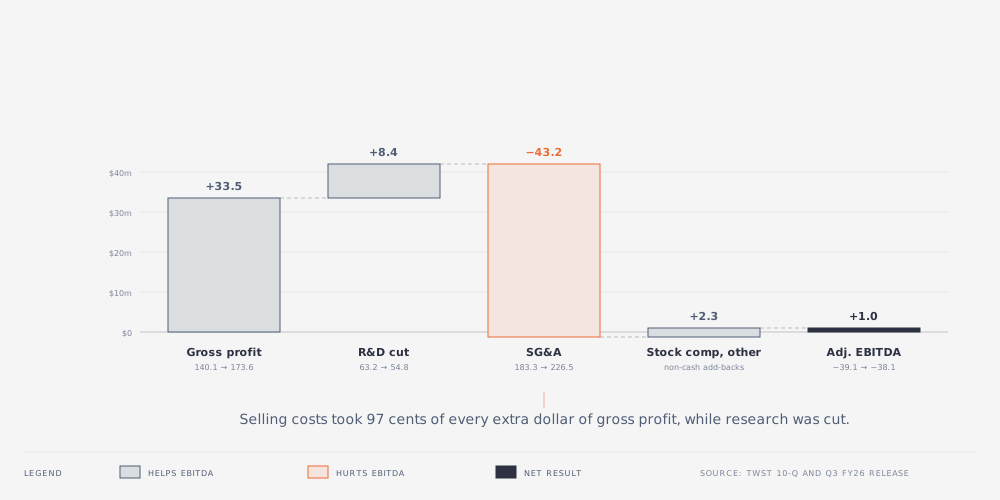
The bridge carries one more thing worth naming. Research and development spending fell across the same nine months, from $63.2 million to $54.8 million, a cut of about 13%. The extra $43.2 million of selling and administrative cost was therefore not funded by gross profit alone. Part of it came out of research, at a company whose case rests on being the cheapest and fastest place to buy a gene.
The obvious defence is that a stock which quadrupled inflates stock-based compensation, and compensation sits inside SG&A. The filings close that off. Stock-based compensation was $50.4 million for the nine months against $48.4 million a year earlier, a rise of about 4%. SG&A rose about 24%, so the increase is cash spending rather than an artefact of the share price.
One quarter that was not what it looked like
Twist reported net income of $20.4 million for the quarter ended June 30, 2025, its only positive quarter in the period we examined. It included a $48.8 million gain from spinning out its DNA data storage business as Atlas Data Storage. Operating loss that quarter was $30.1 million.
Anyone scanning a summary table for the moment Twist turned profitable will land on that quarter, and what they will have found is a divestiture.
What "adjusted EBITDA breakeven" is measuring
Management reiterated that it expects adjusted EBITDA breakeven in the quarter ending September 30, 2026. Adjusted EBITDA was negative $11.3 million in the June 2026 quarter, so the target is close and probably reachable.
It is worth reading the definition, which the release gives. Adjusted EBITDA excludes interest income, income tax, depreciation and amortisation, litigation settlement costs, other income and expense, and stock-based compensation. Stock-based compensation was $18.2 million in that quarter alone. A company hitting adjusted EBITDA breakeven while running $18 million a quarter of equity compensation is not at GAAP breakeven and is not generating cash. The CEO's framing was that the milestone "is not the destination", which is fair, but the distance from it to cash generation is roughly the compensation line plus capital expenditure.
The comparison the thread reached for
One commenter pushed back usefully on a Seagen analogy:
Twist provides services. Valuation thesis will be more similar to a standard services on the basis of contracts for orders etc.
That instinct was right, and a peer makes the point. Azenta, a tools and services company of similar scale, booked $161.2 million of revenue in the quarter ended June 30, 2026 and spent 41.7% of it on SG&A. Twist spent 68.2% of revenue on SG&A in its June 2026 quarter. The thread argued about gross margin. The gap sits below it.
What nobody in the thread mentioned
The strongest thing that happened to Twist over the past year was not in the thread at all. The BIOSECURE Act was signed into law on December 18, 2025 as part of the fiscal 2026 National Defense Authorization Act, restricting US federal procurement from designated Chinese biotechnology companies. GenScript, named by the original poster as a competitor, has been the subject of Congressional referrals to the ODNI and the FBI. The Office of Management and Budget must publish its list by December 2026.
Twist manufactures in Oregon. If a meaningful share of the customer base is federally funded and a principal low-cost competitor is Chinese, that is a durable change in the competitive setting, and it re-rates a multiple rather than a quarter. It is also the least quantified part of the bull case right now, because the list does not yet exist.
Where we land
The poster was right and the reasoning in the replies was mostly wrong. Demand was real and is visible in genes shipped. The commodity-trap argument that dominated the bear case was refuted by 19 points of gross margin expansion. The one bear who talked about operating cash flow has been right throughout.
Operating leverage has not appeared. Three fiscal years of margin expansion have produced no improvement in adjusted EBITDA over the most recent nine months, and cash flow from operations deteriorated. That is the question the next four quarters answer, and it is a different question from the one the thread was arguing.
Then there is the capital raise. On August 5, 2026, Twist sold 3,125,000 shares at $96.00 for $300 million gross and approximately $284.3 million net, with an option on 468,750 more. It held approximately $167 million in cash and short-term investments at June 30, 2026, against 62,707,424 shares outstanding at July 29. A company one quarter from adjusted EBITDA breakeven raised roughly 1.8 times its existing cash balance, days after its stock reached a multi-year high, and named expansion of manufacturing capacity among the uses.
That is either good opportunism or a signal that breakeven and self-funding are further apart than the headline suggests. Guidance for the September quarter is revenue of $123 million to $124 million and adjusted EBITDA breakeven.
Not investment advice. We hold no position.
Sources
- Twist Bioscience, fiscal third quarter 2026 results, August 3, 2026: https://www.sec.gov/Archives/edgar/data/1581280/000158128026000044/twst-2026630xex991.htm
- Twist Bioscience, Form 10-Q for the quarter ended June 30, 2026: https://www.sec.gov/Archives/edgar/data/1581280/000158128026000047/twst-20260630.htm
- Twist Bioscience, prospectus supplement (Form 424B5), August 5, 2026: https://www.sec.gov/Archives/edgar/data/1581280/000110465926091202/tm2622018-3_424b5.htm
- Twist Bioscience XBRL company facts, US Securities and Exchange Commission: https://data.sec.gov/api/xbrl/companyfacts/CIK0001581280.json
- Azenta XBRL company facts, US Securities and Exchange Commission: https://data.sec.gov/api/xbrl/companyfacts/CIK0000933974.json
- Twist Bioscience, Atlas Data Storage spin-out announcement, May 5, 2025: https://www.businesswire.com/news/home/20250505213784/en/Twist-Bioscience-Spins-Out-DNA-Data-Storage-as-Independent-Company
- Ropes & Gray, BIOSECURE Act enacted, January 2026: https://www.ropesgray.com/en/insights/alerts/2026/01/biosecure-act-enacted
- Original thread, r/stocks, August 30, 2025: https://www.reddit.com/r/stocks/comments/1n4c77y
Discussion
Nobody has replied yet. If the argument here is wrong, say so.