Source: u/Secret_Swordfish4121 in r/ValueInvesting, July 12, 2026, and the longer version the same author published as Mazen Mahdi on Substack, The Current State Of Vertex. The framing, the acquisition clock and the valuation work are theirs. We checked their figures against the filings and then against the quarter that landed three weeks later. The recomputations are ours.
The claim
The analysis argues that Vertex is a superb business resting on one disease, and that its record of buying its way to a second one is thin. Cystic fibrosis was about 98% of product revenue. The franchise came from a 2001 acquisition that took eleven years to produce an approved drug and eighteen to produce a blockbuster. Five acquisitions since have produced almost no revenue. Vertex has now paid roughly $10 billion in cash for Crinetics, and the stock fell about 8% on the news.
The author's own summary of the tension:
Patient franchise-builder, or serial buyer of pipelines that don't pay off?
Every number in that analysis checks out. Cystic fibrosis was $2,915.0 million of $2,986.9 million in the March quarter, which is 97.6%. Cash and marketable securities were $12,996.6 million at March 31. Revenue grew 8.9% in 2025, to $12,001.3 million. Vertex closed at $529.59 on July 6 and $485.39 on July 10, a fall of 8.3%. That is a better sourcing record than most sell-side work, and it is worth saying plainly before disagreeing with anything.
What the analysis could not include is the quarter Vertex reported on August 3, three weeks after publication. It moves three of the numbers the argument rests on.
The concentration moved for the first time
Cystic fibrosis was 96.2% of second-quarter revenue, against 97.6% in the first. That is a small number and an important one, because it had not moved in years.
The non-cystic-fibrosis products are what shifted it. Casgevy and Journavx together made $126.0 million in the June quarter, against $71.9 million in the March quarter the analysis was written from. That is 75% growth in three months, off a base the author fairly called a rounding error.
| Product | Q2 2025 | Q2 2026 | Change |
|---|---|---|---|
| Casgevy | $30.4M | $76.4M | +151% |
| Journavx | $12.0M | $49.6M | +313% |
| Total non-CF | $42.4M | $126.0M | +197% |
Vertex also put a number on it going forward. Full-year guidance rose to $13.1 billion to $13.2 billion, and the company said that embeds "$500 million or more in revenue from non-CF products, namely CASGEVY and JOURNAVX". That is roughly 4% of revenue rather than 2%, which is not diversification, but it is the first year the line is large enough to be worth a sentence in guidance.
Trikafta is shrinking, and that is the strategy working
Trikafta and Kaftrio made $4,851.9 million across the first six months of 2026, down from $5,086.6 million in the same half of 2025, a fall of 4.6%. Over the same six months Alyftrek went from $210.7 million to $998.0 million.
Total cystic fibrosis revenue rose 10.6% year over year in the quarter even so. When a franchise grows while its largest component shrinks, patients are moving between products inside it.
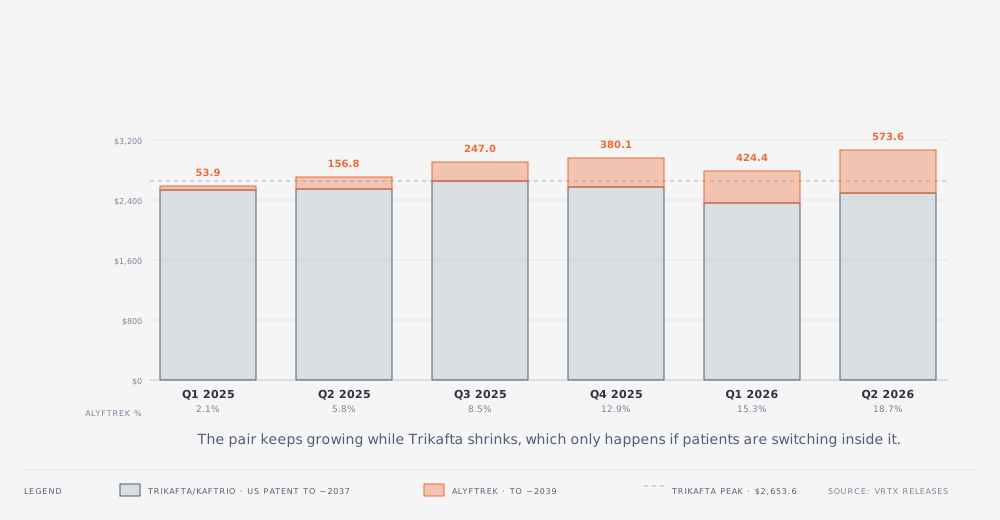
Across six quarters the switch is steady rather than sudden. Alyftrek was 2.1% of the two drugs combined in the March 2025 quarter and 18.7% in the June 2026 quarter, and Trikafta has not matched its September 2025 peak of $2,653.6 million since.
That is the lifecycle strategy the analysis described, showing up in the income statement rather than in a patent table. The author noted that Trikafta is protected in the US to roughly 2037 and Alyftrek to roughly 2039, and that Vertex can move patients onto the newer drug before the older cliff arrives. The June quarter is that happening. A reader who sees Trikafta declining and reads it as erosion has the sign backwards.
It also dates one of the analysis's framings. Trikafta was 78.8% of revenue in the March quarter and 74.9% in the June quarter. The "one drug is 79% of the company" line was accurate when written and is drifting by design.
The cash has not left yet
The acquisition had not closed when we checked, and Vertex said it expects to close in the third quarter. No filing since the August 4 quarterly report records completion.
Meanwhile the balance sheet grew. Cash and marketable securities were $13,641.5 million at June 30, up from $12,996.6 million at March 31. The analysis modelled net cash falling to roughly $4 billion after the deal. On the June balance and the stated $8.8 billion net cost, the figure is closer to $4.8 billion. That is a modest correction rather than a different conclusion: Vertex is still spending most of its cushion.
The market is not treating the close as uncertain. Crinetics finished at $84.70 on August 14 against an $85.00 cash offer, a spread of about 0.4%.
The cost of the second act arrives before the revenue
Selling, general and administrative expense was $582.2 million in the June quarter, against $424.6 million a year earlier, a rise of 37% on revenue growth of 12%. Vertex attributes it to the Journavx launch and to building a renal commercial organisation ahead of the povetacicept decision due November 30. That, rather than concentration, is the part of the quarter that argues for the bear.
That is what buying a second franchise looks like on the way in, and Vertex can afford it: net income was $1,099.8 million for the quarter. But it is the mechanism by which diversification costs money for several years before it makes any, and it is the line to watch if the non-cystic-fibrosis products stall.
What the thread argued about instead
The comments went to the quality of the acquired science. One reply made the strongest version of the bull case:
Overall I think it's fair to say that Vertex has acquired a company no dissimilar to itself, albeit earlier in the cycle, so we can easily see this acquisition as a net positive for Vertex.
That may be right, and it is not checkable from a filing. Palsonify made $10.3 million in the March quarter, which is where a $1 billion forecast starts, not where it is tested. Vertex's raised guidance contains no Crinetics revenue at all, because the deal has not closed.
Nobody in the thread mentioned the Alyftrek switch, which is the part of the story already visible in the accounts.
Where we land
The analysis holds up, with one framing now out of date. Concentration is real, at 96.2%, and the acquisition record is still thin. The Aurora clock remains a fair warning about how long Vertex's bets take to pay.
The correction is that the second act had already started moving in the quarter after publication, in two places. Non-cystic-fibrosis revenue grew 75% in three months and now carries a guidance line of its own. Trikafta is declining while total cystic fibrosis revenue grows, which is Vertex trading a 2037 patent for a 2039 one and accepting a smaller headline number to do it.
Neither is a verdict on the $10 billion. Crinetics contributes nothing to any figure above, has not closed, and will be judged on whether Palsonify reaches the revenue the thread assumes. What the quarter does change is the premise the bear case starts from. Vertex was a company where 98% of revenue came from one disease and nothing else was moving. In the June quarter, 96.2% came from one disease and two other products roughly tripled.
Vertex closed at $505.75 on August 14, above the $485.39 the analysis was written at, with 253,460,924 shares outstanding as of July 31.
Not investment advice. We hold no position.
Sources
- Vertex, second quarter 2026 results, August 3, 2026: https://www.sec.gov/Archives/edgar/data/875320/000087532026000256/ex-991_q22026.htm
- Vertex, Form 10-Q for the quarter ended June 30, 2026: https://www.sec.gov/Archives/edgar/data/875320/000087532026000259/vrtx-20260630.htm
- Vertex, Form 8-K on the Crinetics agreement, July 7, 2026: https://www.sec.gov/Archives/edgar/data/875320/000119312526296710/d113650d8k.htm
- Vertex XBRL company facts, US Securities and Exchange Commission: https://data.sec.gov/api/xbrl/companyfacts/CIK0000875320.json
- Mazen Mahdi, The Current State Of Vertex (VRTX), July 12, 2026: https://secaura.substack.com/p/the-current-state-of-vertex-vrtx
- Original thread, r/ValueInvesting, July 12, 2026: https://www.reddit.com/r/ValueInvesting/comments/1uuhip2
- Closing prices from Databento EQUS.SUMMARY end-of-day bars.
Discussion
Nobody has replied yet. If the argument here is wrong, say so.