Source: a due-diligence post on r/Biotechplays by u/DrBioDude, July 2026, with four charts in the comments. They disclose a long position, and a SEK 40 fair value against a SEK 15.68 share price. The thesis and the scenario ladder are theirs. The recomputations are ours, and every input we use points at a company report, a regulator, or a journal.
The claim
Vicore Pharma is one drug. Buloxibutid, taken orally, for idiopathic pulmonary fibrosis: a disease that scars the lungs until they stop working, with median survival of two to three years from diagnosis. The drugs that already exist slow the decline and are hard to stay on.
Buloxibutid works on a receptor nobody else in IPF is aiming at, the angiotensin II type 2 receptor, which sits on the protective arm of a system better known for blood pressure. Vicore's claim is not that the drug slows the scarring. It is that the lung repairs. One trial decides this, ASPIRE, reading out mid-2027.
The author flags the weakest part of their own case before anyone else can:
Being explicit: putting AIR's absolute +216 (or +9.4) mL next to a competitor's placebo-adjusted +69 mL is NOT like-for-like — I'm flagging it rather than glossing over it.
Good instinct, and rarer than it should be. But the comparison can be made, roughly, and it comes out better for Vicore than the post claims. What does not survive is the floor the word "asymmetric" is resting on.
First, which patients you count
AIR, the phase 2a trial, had no placebo group. Open-label, single-arm, treatment-naïve patients, 100 mg twice daily, 36 weeks.
The number everyone quotes from it is +216 mL of forced vital capacity gained from baseline. Vicore's own release attaches an n to that: 28 patients. When Vicore presented AIR again at ERS in 2025, this time against a constructed comparator group, the treated arm was 48 patients gaining 23.2 mL.
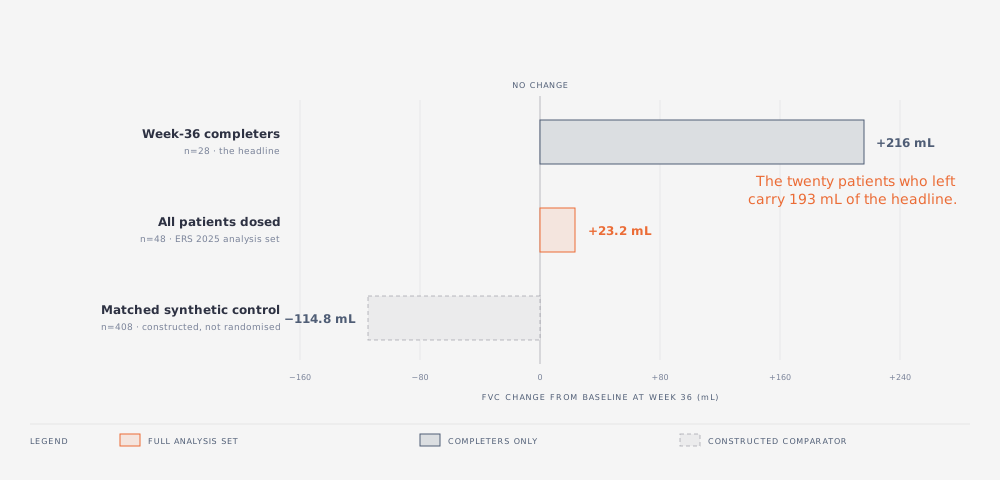
Same trial, same endpoint, same week 36. What separates "this drug repairs lung tissue" from "this drug roughly holds the line" is twenty patients who never reached a week-36 measurement. In a fatal progressive disease, the people who leave a trial early are not a random sample of the people who stay.
Two notes on precision. The DD cites +9.4 mL for a pre-specified imputed analysis. That figure appears in no company release, abstract or press report we could find, so this note uses the 23.2 mL Vicore presented. And 23.2 mL is still a positive number in a disease where untreated lungs lose volume every month. That is the genuinely interesting thing in this file. It is just not 216.
The comparison the post said couldn't be made
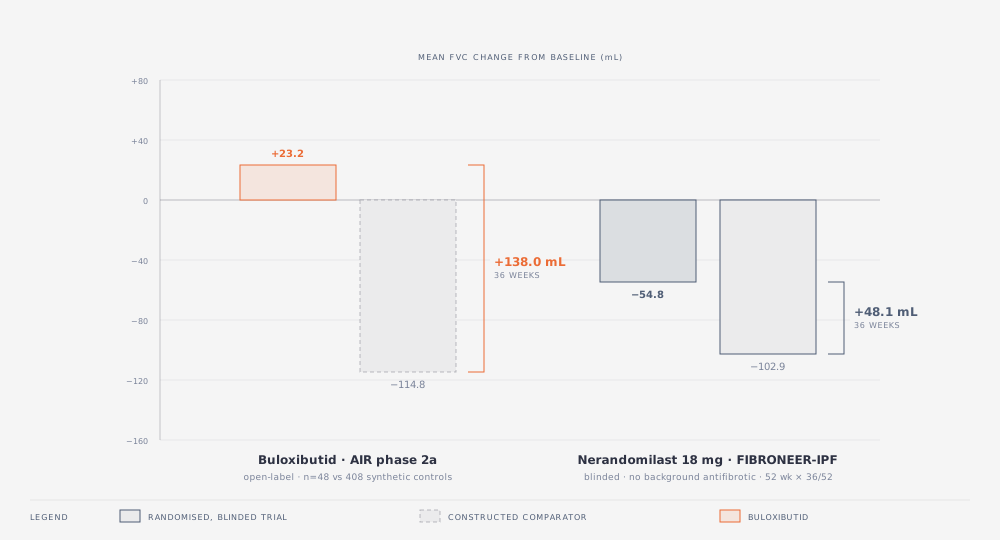
AIR's numbers are absolute, change from baseline with nothing subtracted, while nintedanib's and nerandomilast's are placebo-adjusted. The DD is right about that. But AIR does have a comparator now. The ERS 2025 analysis matched its 48 treated patients against 408 synthetic controls built from real-world data, and those controls declined 114.8 mL over the same 36 weeks.
Nerandomilast's phase 3 published a subgroup that took no background antifibrotic, the closest thing to AIR's treatment-naïve population. Placebo there fell 148.7 mL over 52 weeks; the 18 mg arm fell 79.2 mL.
Put both on a 36-week clock:
| Comparator | Drug arm | Difference, 36 weeks | |
|---|---|---|---|
| Buloxibutid, AIR | −114.8 mL (constructed, n=408) | +23.2 mL (n=48) | +138.0 mL |
| Nerandomilast 18 mg, FIBRONEER-IPF | −102.9 mL (randomised) | −54.8 mL | +48.1 mL |
The synthetic control turns out not to be rigged. It declines 114.8 mL over 36 weeks against the real randomised placebo's equivalent of 102.9 mL, about a tenth steeper. A comparator group built to flatter the drug would have looked far worse than that.
And on the conservative cut, buloxibutid's effect is roughly 2.9 times nerandomilast's. The post disclaims the "3×" comparison and is right that +216 mL cannot carry it. But 138 against 48 gets there anyway, using the number the post itself treats as its pessimistic case.
None of which is evidence. The 138 mL comes from 48 unblinded patients measured against a comparator that was constructed rather than randomised, and the 48.1 mL is a linear pro-rating of a 52-week result, which assumes FVC falls at a constant rate. IPF is littered with open-label single-arm numbers that looked encouraging and then failed in a real trial. Pamrevlumab and ziritaxestat both did. This is a reason to run ASPIRE. It is not a reason to price it as finished.
So the clinical half of the thesis is in better shape than the author's own hedging suggests. The other half is where it comes apart.
The floor
Everything the DD calls asymmetric rests on one number: if ASPIRE fails, the stock lands on net cash at about SEK 5 a share, "a hard, empirically-observed floor."
That floor is not there. Vicore's most recent report puts cash and short-term investments at SEK 1,059.8 million on 31 March 2026, against 281,525,593 shares. SEK 3.76 a share, today, before ASPIRE has said anything.
And it keeps falling. The same report shows SEK 117.6 million of operating cash outflow in the quarter. Run that rate to the readout:
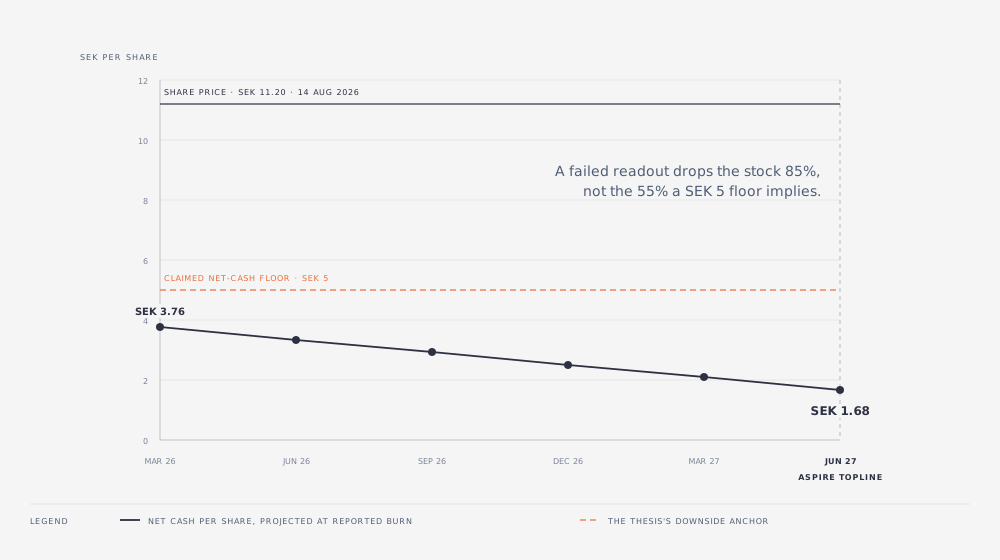
Roughly SEK 470 million left at topline, or SEK 1.68 a share. Management's own guidance is the check on this: they say the runway reaches into the second half of 2028, and SEK 1,059.8m burned at SEK 117.6m a quarter runs dry in mid-2028. Two routes, same answer.
At today's SEK 11.20 that changes the shape of the bet.
| If ASPIRE fails | Implied downside |
|---|---|
| To the claimed SEK 5 floor | −55% |
| To net cash as actually reported | −85% |
A failed trial also does not leave a company sitting quietly on its cash pile. It leaves a board choosing between a wind-down and a pivot, and biotechs in that position routinely trade below net cash for months. SEK 1.68 is a ceiling on the downside, not a floor under it.
The instructive part is how little this moves the headline. A failure branch weighted at 35% contributes SEK 1.75 with a SEK 5 floor and SEK 0.59 with a real one, so the probability-weighted average slides from SEK 39 to SEK 38. The correction is almost invisible in the target and total in the risk. That is what averaging over a binary does to you. The mean stops describing anything you can actually own.
The sensitivity table has one number in it
The DD's second chart is a 30-cell grid of fair value by net price and approval probability, presented as the two variables the case turns on. Read down any column and the grid collapses to a multiplication:
value in SEK ≈ approval probability × net price in thousands of dollars
30% × $105k gives the 31 in that cell. 80% × $105k gives 84. 45% × $219k gives 98. All thirty cells reproduce within a rounding step. The two axes never interact, and the model carries no net cash term and no dilution term. It is one rNPV point scaled linearly in two directions and coloured in.
Which tells you something about the third chart. The DD plots "market-implied (current price)" at 30% approval probability, sitting right on top of its own 28 to 32% base case. Run the price back through the grid, though. At the post's own SEK 15.68 and its own "defensible" $105k net price, the market was paying for 15%. At SEK 11.20 today, 11%.
You would need a net price near $52k to get a market-implied 30%, half what the same post calls defensible. The two charts disagree by a factor of two, and the direction is the good news: the real gap with the market is about three times larger than the post claims. The thesis reduces to this: the market prices 11% odds of approval, and the author puts them at 28 to 32%. That is a respectable argument. It is never actually made.
The financing nobody priced
Dilution appears in the risk list and in none of the four scenarios. Vicore's own history prices it. In a directed share issue announced in November 2025 the company sold 46,915,822 shares for SEK 455 million, about SEK 9.70 a share against SEK 11.20 today. That raise bought roughly four quarters of burn and cost shareholders a fifth of the company, taking the count from 234.6 million shares to 281.5 million.
A phase 3 IPF programme is conventionally two trials, each bigger than ASPIRE's 360 patients and running the same 52 weeks. Vicore's whole market capitalisation is SEK 3.15 billion, about $330 million. Getting buloxibutid from a positive phase 2b to a filing costs a serious fraction of what the entire company is worth, and none of it is funded.
Haircut the three non-failure branches by 15% for that and the DD's own ladder gives SEK 32 instead of SEK 39. Survivable. But every per-share figure in the post is calculated on a share count that cannot survive the scenario the figure is describing.
What the post gets right
More than the sections above suggest. The probabilities are internally consistent: 25% plus 20% is the 45% readout-positive figure, which sits mid-band in the post's own evidence hierarchy. The weighted average is arithmetically correct. And the pricing assumption is conservative rather than aggressive. Boehringer lists nerandomilast at $16,219.68 a month, about $194,600 a year, which makes the DD's "defensible" $105k net price a 46% discount to what the newest entrant already charges. The market sizing is probably low too. Ofev alone sold €3.8 billion in 2025.
What the post underplays is nerandomilast itself, which it treats as a comparator datapoint and nothing more. The FDA approved it for IPF on 7 October 2025 and for progressive pulmonary fibrosis that December. It is oral, twice daily, and carries none of nintedanib's gastrointestinal burden.
That takes away the second pillar of the thesis. "Well tolerated oral drug, so patients stay on it, so revenue beats the label" no longer describes buloxibutid's opening. It describes a drug that will have been on the market two years by the time ASPIRE reads out. What is left for buloxibutid is the harder claim and the more valuable one: not better tolerated, but the only treated arm that produces a positive number. That is exactly what ASPIRE is powered to test, and it is a much narrower door to walk through.
Where we land
The clinical case is stronger than the author's own hedging implies and the financial case is weaker than the headline. Those roughly cancel, and the probability-weighted value comes out in the low SEK 30s against SEK 11.20 today. The stock has fallen 29% since the DD went up, so the gap it describes is wider now than when it was written. The thesis got cheaper, not wronger.
What changes is sizing. "Anchored downside at SEK 5" describes a position you can hold through a readout. A real downside of SEK 1.68 and falling, in a single-asset company that has to raise money whatever happens, describes a much smaller one. Same target price, different bet.
What to watch, in order.
Q2 2026 results land on 21 August, five days from now. They refresh both inputs the floor argument depends on, the cash line and the quarterly burn.
Then the financing. The runway reaches into the second half of 2028; a phase 3 does not. Whether that money is raised before or after the readout decides most of the per-share upside either way.
Then ASPIRE topline, mid-2027. Enrolment closed in April 2026: more than 360 patients across 100 sites in 14 countries, on 50 mg or 100 mg twice daily, as monotherapy and on top of standard of care, with FVC at 52 weeks. It is the first randomised, blinded number this drug will ever produce, and it settles everything else on this page.
Not investment advice. We hold no position.
Sources
- u/DrBioDude's DD on r/Biotechplays, July 2026, and its four comment charts
- Vicore: interim report January–March 2026 (cash, burn, runway)
- Vicore: ASPIRE enrolment complete
- Vicore: final phase 2a AIR results (+216 mL, n=28)
- Clinical Trials Arena: buloxibutid's synthetic control arm at ERS 2025 (+23.2 mL, n=48, vs −114.8 mL, n=408)
- Nerandomilast in Patients with Idiopathic Pulmonary Fibrosis, NEJM · AJMC summary of the no-background-antifibrotic subgroup
- Boehringer: FDA approves Jascayd for IPF · Jascayd list price
- Vicore: directed share issue, SEK 455m · Nasdaq ADS listing, July 2026
- Boehringer Ingelheim FY2025 results (Ofev sales)
- Share price and share count: stockanalysis.com/quote/sto/VICO, close of 14 August 2026
Discussion
Nobody has replied yet. If the argument here is wrong, say so.